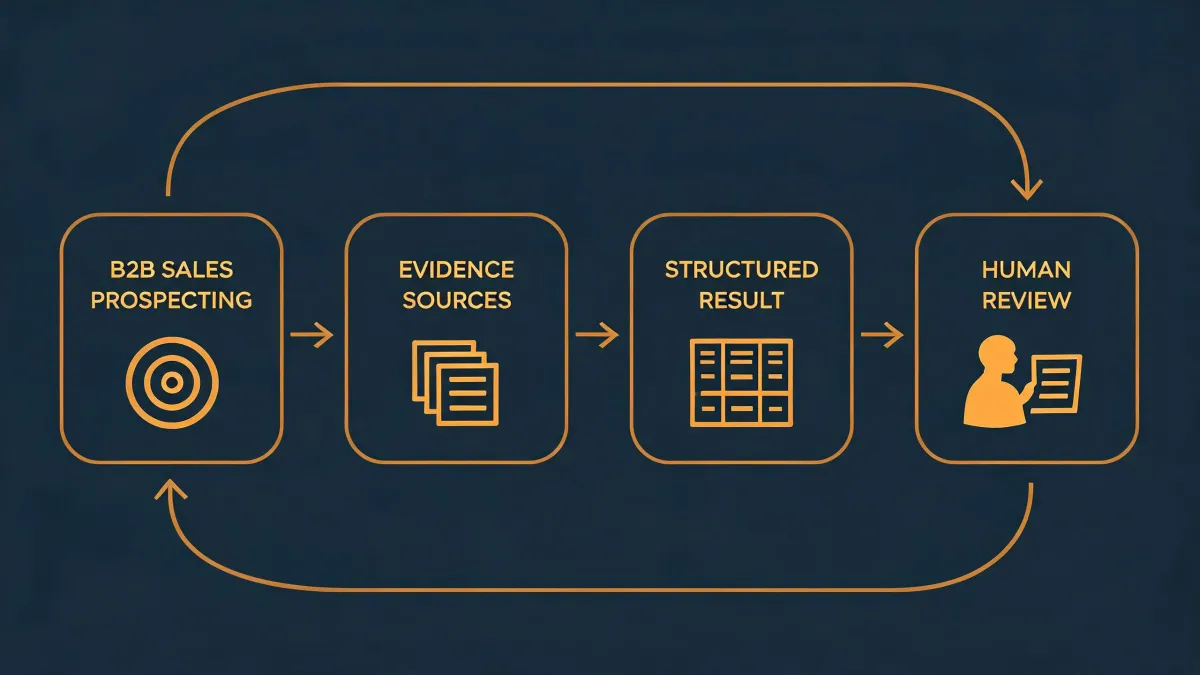
- Establishing the Operating Record's Foundation: Source Capture and Provenance
- Navigating the Review Path: Duplicate Conflict, Assignment, and Qualification
- Testing the Limits: Exception Handling and Conversion Dynamics
- Refining the Pipeline: Rejection, Correction, and Misconception Management
- Applying the Decision Rule: Closed-Loop Learning for Continuous Improvement
- Frequently asked questions
Effective lead generation hinges on more than just accumulating contact details; it requires a systematic approach to managing lead data that prioritizes accuracy and actionable intelligence. A Customer Relationship Management (CRM) system supports lead generation most effectively when it precisely records the initial reason a lead exists and translates that reason into a series of governed next actions, rather than functioning as a simple repository for contact records. This process demands a rigorous framework for data quality, encompassing defined dimensions, consistent measurement, continuous improvement, and clear ownership. The integrity of an operating record, from its initial capture to its ultimate disposition, dictates the efficiency and compliance of the entire lead generation pipeline.
Establishing the Operating Record's Foundation: Source Capture and Provenance
The journey of a lead within a CRM begins with its source capture, the precise moment and method by which an operating record enters the system. This initial capture is foundational, as it establishes the lead's provenance, its origin story, which is critical for understanding its potential value and compliance standing. For instance, a lead originating from a specific web form submission carries different implications for qualification than one derived from a third-party data enrichment service. Without a clear, auditable trail of its source, subsequent actions taken on the lead lack essential context and justification. Walk one record: source, duplicate, assignment, convert or reject, using Salesforce lead-status and conversion fields as documented objects, not glosses.
I walk one record with vendor field names. Source is Web-to-Lead; Salesforce’s leads help, checked 17 August 2026, treats Lead Status, assignment, conversion, and history as separate objects. Duplicate match hits an existing account; I keep both source stories instead of collapsing them. ICO’s accuracy principle page, same date, requires me to correct or stop using a stale role. The UK Government Data Quality Framework treats that correction as a managed dimension, not a cleanup weekend. If I convert without source and owner, I launder the row.
Preserving the reason a lead exists at the point of capture is paramount. This reason is not merely a tag but a definable attribute that dictates the initial qualification path and subsequent engagement strategy. A CRM that merely stores contact records without this inherent 'reason for being' risks treating all leads uniformly, irrespective of their actual intent or demonstrated interest. This approach undermines the capacity to turn a lead's origin into a governed next action, which is the hallmark of a CRM truly supporting lead generation, rather than simply acting as a contact database.
Government data-quality frameworks underscore the importance of managed practices for defining data dimensions, measuring their adherence, improving data over time, and assigning clear ownership for data integrity. Applied to lead generation, this means that the attributes recorded at source capture, such as event attendance, content download, or direct inquiry, must be precisely defined and consistently measured for accuracy. This structured approach ensures that the lead's provenance is not only recorded but also reliable, forming a trustworthy basis for all subsequent processing steps.
Defining the Essential Elements of Provenance
What truly belongs inside the definition of an operating record's provenance extends beyond a simple source field. It encompasses the specific interaction, the timestamp, the channel, and any associated consent or legal basis for processing. This comprehensive view allows for granular analysis of lead quality and adherence to regulatory principles, such as accuracy. The Information Commissioner’s Office (ICO) guidance emphasizes accuracy as a data-protection principle, noting that inaccurate personal data should be rectified or erased without delay. Therefore, the data captured at the outset must be as accurate as possible, and its origin clearly documented for later validation.
Navigating the Review Path: Duplicate Conflict, Assignment, and Qualification
Once captured, an operating record enters a review path that often begins with duplicate conflict resolution. Detecting and managing duplicates is crucial to maintain data integrity and prevent redundant efforts. A robust CRM identifies potential duplicates by comparing new records against existing ones, using predefined matching rules. This process ensures that sales teams do not pursue the same individual or company multiple times, which can lead to negative customer experiences and wasted resources. The system must provide mechanisms to merge, link, or reject duplicate entries, preserving the most complete and accurate record.
- A CRM supports lead generation when it preserves the reason a lead exists and turns that reason into a governed next action, not when it merely stores more contact records.
- CRM lead status, assignment, conversion, and history as auditable workflow state.
- Reviewed company selection before selective unlock and contact discovery.
- The journey of a lead within a CRM begins with its source capture, the precise moment and method by which an operating record enters the system.
- Applied to lead generation, this means that the attributes recorded at source capture, such as event attendance, content download, or direct inquiry, must be precisely defined and consistently measured for accuracy.
Following de-duplication, the lead record proceeds to assignment. This involves routing the lead to the appropriate sales representative or team based on predefined criteria, such as geographic territory, industry, company size, or specific product interest. Salesforce, for example, documents lead status, assignment, conversion, and history as distinct elements, illustrating the necessity for contact records to possess explicit workflow state and traceable changes. This structured assignment ensures that leads reach the right hands promptly, aligning with the governed next action dictated by their provenance.
Qualification is the next critical step, where the lead's potential is assessed against specific criteria to determine its readiness for sales engagement. This process moves the lead from an initial inquiry to a genuine opportunity. Qualification criteria might include budget, authority, need, and timeline (BANT), or other industry-specific metrics. A CRM facilitates this by providing fields for recording qualification details and allowing for status updates that reflect the lead's progression. This methodical approach ensures that resources are focused on leads with the highest probability of conversion.
Mechanisms for Verification and Validation
The mechanism worth checking in this phase is the auditable workflow state of the CRM. Every change in lead status, assignment, or qualification must be recorded, creating a transparent history. This audit trail is vital for understanding how decisions were made and for identifying bottlenecks or inconsistencies in the process. For instance, when reviewing candidate companies before selective unlock and contact discovery, as documented by OKKI Go, a human review step can refine natural-language search results, ensuring that the initial company data is precise before investing further resources in contact identification. This manual intervention exemplifies a critical check within the automated workflow.
Testing the Limits: Exception Handling and Conversion Dynamics
No lead generation process is entirely linear, and an effective CRM must account for exceptions. An exception occurs when an operating record deviates from the standard workflow due to unusual circumstances, such as incomplete data, an immediate high-priority request, or a specific compliance flag. Handling these exceptions requires predefined protocols within the CRM, ensuring that such leads are not simply lost or ignored but are routed for special review or manual intervention. This flexibility prevents valuable leads from falling through the cracks while maintaining the integrity of the overall process.
The ultimate goal for a qualified lead is conversion. This critical stage transforms a lead into an account, contact, and opportunity within the CRM, signifying its readiness for active sales pursuit. The conversion process is not merely a status change but a migration of data into different record types, maintaining the link to its original lead record and provenance. This ensures that the entire history, from initial capture to qualification, remains traceable. Salesforce, for instance, explicitly documents this conversion as a workflow state, emphasizing the distinct elements involved in this transformation.
The transition from lead to opportunity requires careful data mapping to ensure that all relevant information is carried forward accurately. This includes not only contact details but also the initial reason for the lead's existence and any qualification notes. The CRM's ability to preserve this context during conversion is paramount for empowering sales teams with the full picture, allowing them to tailor their approach based on the lead's demonstrated interest and history. This continuous thread of information supports the thesis that a CRM's value lies in preserving the lead's reason and transforming it into governed action.
The Boundaries of Standard Workflow
Where the rule stops transferring precisely defines the boundaries of the standard workflow. An illustrative scenario might involve a lead that initially appears unqualified but then directly contacts a senior executive. The standard qualification rule might reject it, but the executive contact creates an immediate exception. The CRM must allow for an override, documenting the new impetus and routing the lead accordingly, perhaps to a different sales stage or owner. This ensures that the system is adaptable to real-world scenarios while still maintaining an auditable record of the deviation and its justification.
Refining the Pipeline: Rejection, Correction, and Misconception Management
Not all leads proceed to conversion; some are ultimately rejected. Rejection is a vital part of the lead generation process, preventing sales teams from wasting effort on unsuitable prospects. A CRM must facilitate clear rejection reasons, which are then attached to the operating record. These reasons could range from 'not a good fit' to 'duplicate' or 'incorrect contact information.' Documenting rejections contributes to the governed action framework by providing data for analysis and process improvement, ensuring that future lead generation efforts are more targeted and efficient.
Correction of an operating record is another critical function, addressing inaccuracies identified at any stage. This aligns directly with data quality principles, where inaccurate personal data should be rectified or erased without delay, as per ICO guidance. Whether it's a misspelled name, an outdated phone number, or an incorrect company affiliation, the CRM must provide mechanisms for authorized users to edit and update records while maintaining an audit trail of changes. This ensures the ongoing accuracy and reliability of the lead data, which is fundamental to effective lead generation.
The process of correction extends to more complex scenarios, such as route correction in company search. For example, OKKI Go documents how an initial natural-language company search might yield irrelevant results, necessitating a human review and route correction before selectively unlocking a candidate company and proceeding with contact discovery. This illustrates that corrections can involve not just data fields but also the underlying search or qualification logic, ensuring that the system learns from missteps and guides users towards more accurate outcomes.
Rejecting the Temptation of Superficial Metrics
The tempting interpretation to reject is that lead generation success is solely measured by the sheer volume of contact records stored in a CRM. This misconception ignores the core thesis: a CRM's value is in preserving the lead's underlying reason and translating it into governed actions. A high volume of unvalidated, unqualified, or untraceable leads burdens sales teams and distorts performance metrics. Instead, the focus must remain on the quality, provenance, and actionable nature of each operating record, ensuring that every lead has a clear path and purpose within the system.
Applying the Decision Rule: Closed-Loop Learning for Continuous Improvement
The ultimate stage in the operating record's journey within a CRM is closed-loop learning. This involves analyzing the outcomes of all preceding stages, from source capture and qualification to conversion and rejection, to identify patterns, refine processes, and improve future lead generation efforts. Data on lead sources, qualification rates, conversion success, and common rejection reasons provides invaluable insights. This continuous feedback loop is essential for optimizing marketing campaigns, sales strategies, and the CRM configuration itself, ensuring that the system evolves with business needs.
Closed-loop learning directly informs the ongoing management of data quality. By understanding where data inaccuracies frequently occur or where lead provenance is difficult to ascertain, organizations can implement targeted improvements. This aligns with the framework that treats data quality as a managed practice, emphasizing continuous improvement. For example, if a particular lead source consistently yields low-quality leads, the learning loop might prompt a re-evaluation of that source or adjustments to the initial qualification criteria to prevent similar issues in the future.
The traceability of each operating record, facilitated by auditable workflow states and historical data within the CRM, makes closed-loop learning effective. When every assignment, status change, and conversion is recorded, it provides the granular data necessary for accurate analysis. This systematic approach ensures that improvements are evidence-based, driven by the actual performance of leads through the pipeline, rather than anecdotal observations. This reinforces the principle that a CRM supports lead generation by preserving the reason for a lead's existence and governing its subsequent actions.
The Next Decision Checkpoint: Strategic Refinement
The next decision checkpoint is the strategic refinement of lead generation processes based on the insights gained from the entire operating record lifecycle. This involves adjusting lead scoring models, refining marketing messaging, optimizing lead routing rules, and providing targeted training to sales teams. It is a continuous cycle where data informs strategy, and strategy, in turn, influences how new operating records are captured, processed, and managed within the CRM. This iterative improvement ensures that the CRM remains a dynamic and effective tool for driving high-quality lead generation outcomes.
Trace one lead record through the CRM. If source, assignment, and reject cannot be reconstructed, the CRM is not yet generating governed action.
Frequently asked questions
What is a CRM supposed to preserve in lead generation?
The original reason the record exists and the governed actions taken afterward. A contact pile without provenance is not a lead system.
Which CRM walk-through should a buyer demand?
One record from source to duplicate handling, assignment, and conversion or reject, with field names. A slide of objects is not that walk-through.
How does a duplicate fail a lead CRM?
When two source stories collapse into one row and neither origin can be restored. Duplicate rules are a product decision, not an admin afterthought.
When should CRM conversion be refused?
When source, owner, or acceptance evidence is still missing. Conversion then launders an incomplete record into the pipeline.