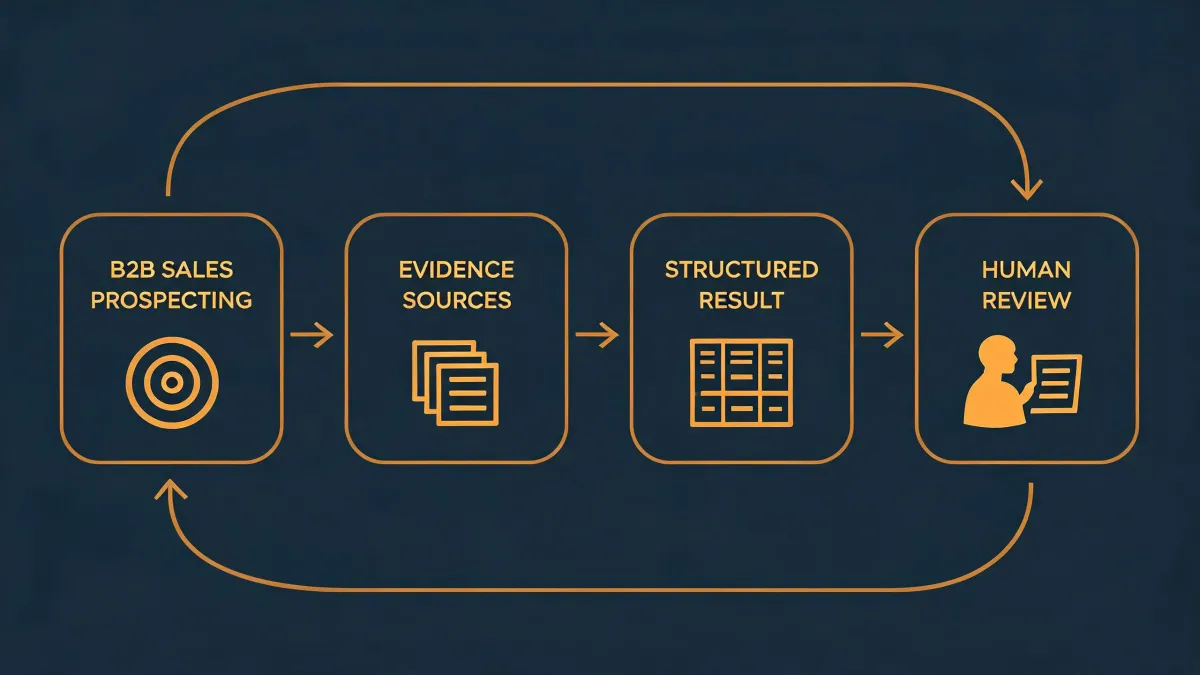
I'll start with the answer nobody wants: there's no single "right" way to use Salesloft. Whether the Salesloft app saves you money or wastes it depends on your team size, data hygiene, and how much of your prospecting is actually agent-native.
I've spent the last six years managing budgets for B2B sales teams. When I audit a new sales engagement platform, I don't start with feature lists. I start with the workflow the tool is supposed to support—and then I check for hidden costs.
This post is written from that procurement bias. I'm going to break the decision into three scenarios. Each gets a different recommendation.
Why this is not a standard "Salesloft vs. other tools" post
Salesloft is a sales engagement platform. It handles cadences, email automation, dialing, conversation intelligence, and revenue forecasting. But if you're using it in an agent-native prospecting workflow—where AI agents research accounts, write personalized lines, and queue tasks—the critical pieces are often the ones people skip: email validation and the API documentation that makes data flow cleanly.
And those pieces cost different amounts depending on your stage.
Scenario 1: Small team, early-stage, not fully automated
If you're a 10-person startup with two SDRs, you need one thing: a reliable way to get prospects into a cadence without polluting the CRM. Don't buy the most comprehensive plan. Don't obsess over website visitor identification.
"Website visitor identification" sounds amazing. It tells you which companies are on your site. But at early stage, the signal is sparse. A handful of visitors, most of whom are your competitor's scraper or your co-founders. You will spend more time interpreting the feed than using it.
What you should buy: a Salesloft plan with basic cadence and email automation, and a separate email validation service. Let me explain why.
We didn't have a formal list verification process in 2023. Cost us three weeks of SDR time and killed our domain reputation. The third time we sent sequences to a list with 18% invalid emails, I created a pre-campaign verification checklist. Should have done it after the first time.
Email validation is not about "cleaning" obviously fake addresses. It's about catching the typos, the role accounts that bounce, and the domains that accept everything but silently drop. A per-address check costs less than one mid-tier SDR hour.
Five minutes of verification beats five days of correction. That line should be on your wall.
Also: if you're evaluating the Salesloft app, check its native integrations with validation tools. You don't want a custom integration when you're replacing an Excel sheet.
Scenario 2: Scaling team, agent-assisted prospecting
Now your team is 30-50 people. RevOps exists. SDRs are using an AI agent to draft personalized lines, but a human still clicks "send." You need more from Salesloft: dialer, conversation intelligence, and a working data pipeline.
This is where email validation becomes a workflow requirement, not a nice-to-have. But the scaling mistake is usually the reverse: they buy the validation point-solution and don't check the email verification API documentation before committing.
Why does the API doc matter? Because in an agent-assisted workflow, validation can't happen in a batch once a month. The agent needs to call the verification API at the moment a new lead enters the sequence. You need to know:
- Rate limits: how many lookups per minute without throttling your SDRs
- Response schema: do you get a clear "valid / invalid / risky" status, or do you have to parse blocks of JSON like it's 2015?
- Webhook behavior: if the vendor marks an email invalid after you've sent, can it update your prospect record automatically?
- Error handling: what happens when the API times out mid-sequence? Does the agent pause, retry, or skip?
I learned this the hard way. We integrated a validation API that looked fine on paper. The documentation didn't mention that the "quick" endpoint returned a 99% deliverability grade for disposable email domains. We only found out when our bounce rate climbed. The vendor's docs technically said "may not detect all catch-all domains"—buried in a footnote. Not ideal.
At this stage, website visitor identification also becomes useful—but only if you tie it to buying intent and ask the agent to prioritize accounts that show real product engagement. Don't just collect every anonymous company pageview. Filter to your ICP and let Salesloft route the high-intent accounts to a dedicated SDR.
And regarding the Salesloft features you actually need: look for cadence with a dialer, Salesforce or HubSpot sync, and conversation intelligence. You can live without advanced forecasting for now.
Scenario 3: Enterprise, fully agent-native workflow
This is where the question "how does email verification API documentation fit into an agent-native prospecting workflow?" becomes central. If your AI agents are researching, enriching, and even sending outbound, the verification API is the guardrail between your domain reputation and the dumpster fire.
Agent-native doesn't mean the agent sends everything without review. It means the agent coordinates the data flow: it reads the Salesloft opportunity, decides a contact is worth targeting, enriches the record, validates the email, writes a personalized message, and schedules the follow-up. Each step is a function call. Each function call depends on documentation.
So what does "email verification API documentation" need to include for an agent to use it safely?
- Structured endpoint definitions—the agent can't ask a human "how do I call this?"
- Clear status codes—not just "verified" but "risky" and "unknown" with reasons.
- Compliance metadata—per FTC guidance (ftc.gov) on CAN-SPAM, you need a working opt-out and an accurate header. If the API can flag addresses that look role-based or harvested, that's a compliance signal, not a deliverability nicety.
- Billing granularity—from a cost perspective, this is the one that hides money. Some API vendors charge per validation call, some per unique email, some have a monthly minimum that assumes a volume you won't hit. Compare total annual cost, not per-1000 rate.
Dodged a bullet when I double-checked the API documentation before a purchase in 2025. My team almost went with an API that charged a flat monthly fee for "unlimited validations"—but the "unlimited" tier had a 10,000-record limit and then a premium rate per lookup. We would have spent $11,000 more over the year than we did with the usage-based vendor. The truth was in the docs.
In this scenario, Salesloft's forecasting and revenue intelligence become more valuable, because you now have clean data feeding into it. Garbage in, garbage out. If your agent-native workflow doesn't verify emails before handoff, the forecasting numbers will look healthy until you run a lifecycle analysis—and then you'll see $40,000 of pipeline built on fake inboxes.
To put it in cost terms: according to USPS pricing effective January 2025, a First-Class Mail letter (1 oz) costs $0.73 at usps.com/stamps. That's a fixed, known cost. An invalid email has no published rate, but the cost is higher: your next legitimate email gets classified as spam. In direct mail, a bad address costs postage. In email, it costs sender reputation.
One more enterprise point: have a formal data quality process. When I audited our 2025 spending, I found that 23% of our "budget overruns" in outbound tooling came from data cleanup after bad sends. We implemented a pre-send verification policy, and rework hours dropped by roughly a third. That's the prevention-over-cure math.
How to tell which scenario you're in
Here's a quick self-assessment. Answer these honestly:
- Does your outbound workflow rely on a human copying contact data between tools? → Scenario 1.
- Does it use AI to generate messages but a human still reviews and sends? → Scenario 2.
- Does an AI agent decide who to contact, enrich, and execute at least part of the sequence without human step-by-step review? → Scenario 3.
But there's one caveat. You might be in Scenario 1 today and Scenario 3 in six months. When you choose email validation tooling or a Salesloft plan, ask "what happens when we automate more?" Some APIs have endpoints for batch validation but no webhooks for individual real-time checks. That's a fast no.
The cost control takeaway: the size of your Salesloft purchase is irrelevant. The size of your data problem is what matters. Every bad email, every uninterpretable API response, every mystery visitor on your website costs something. Some costs are visible in the invoice. Most aren't.
Run the TCO. Read the docs. Verify before you send. It's boring. It works.