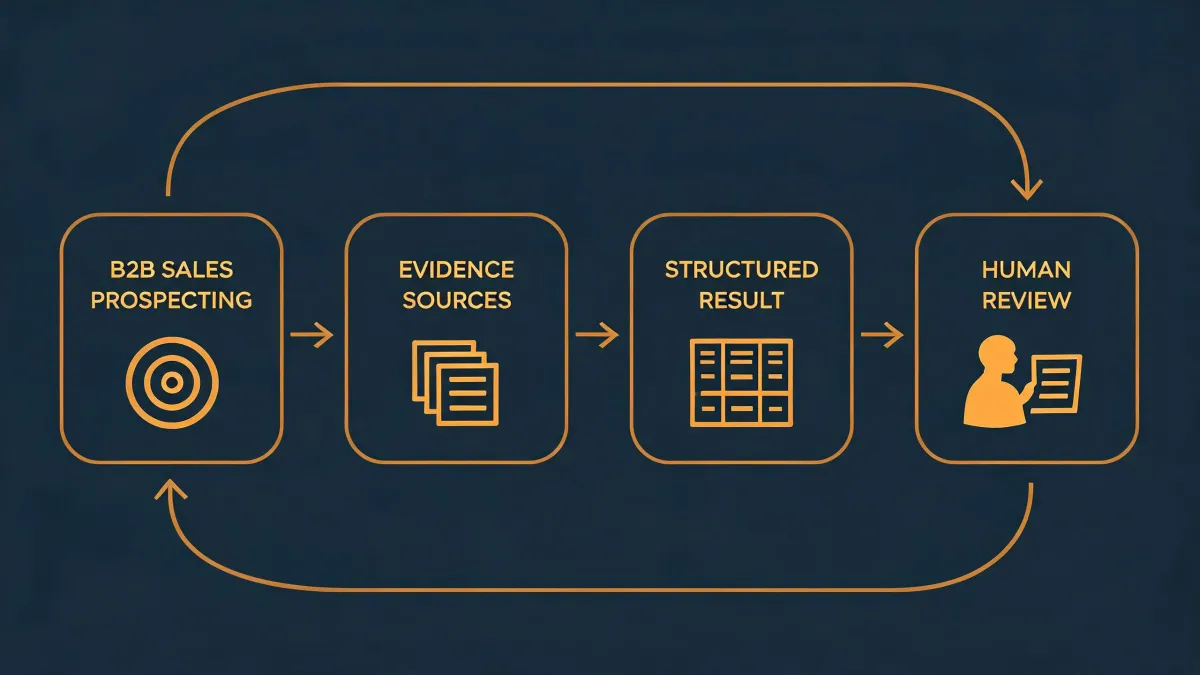
A cold email lead generation agency should be evaluated as a controlled operating system, because list acquisition, mailbox operations, and reply handling can each invalidate the agency's claimed pipeline contribution. An agency can report meetings while leaving the client with damaged domains, disputed records, unusable replies, or an attribution gap. The service must be evaluated as an operating system.
What it is, in one line
A cold email lead generation agency should be purchased as an operating system with explicit asset, data, acceptance, and exit ownership. Begin with a written accepted-lead definition: company type, geography, product relevance, current role, source, freshness, exclusions, and what is not promised. A matching record is not proof of demand, budget, or permission. The client should retain ownership or assured export rights for domains, mailboxes, DNS records, suppression history, research evidence, sent copy, replies, and dispositions rather than receiving only a weekly “lead” spreadsheet.
- Client ICP and exclusions are versioned and testable.
- Every company and person field retains source and observation date.
- Mailbox, domain, suppression, reply, and CRM assets have named owners.
- Exit export includes history, corrections, credentials transition, and open states.
What belongs inside the definition
Google sender guidance, FTC CAN-SPAM guidance, and vendor workflow pages address different pieces. None independently certifies an agency’s targeting, permission, delivery, or results. The acceptance clause should name required company and person fields, source freshness, exclusions, duplicate rules, and accepted, held, or returned states. Volume is not accepted work until the client can reconstruct those fields. Ask for complaint, bounce, and attribution files beside the meeting report. Meetings without those files leave the client holding mailbox risk.
How it works
Worked handoff: an agency submits Riverbend Components as an accepted German distributor and identifies Lena Ortiz as purchasing lead. The client rejects the record because the cited page belongs to a similarly named retailer and Lena works for that retailer. The agency marks an entity mismatch, closes the dependent person and draft, preserves the rejected version, and returns the company to identity review. It does not substitute another contact while leaving the wrong company approved. The client’s rejection uses a contract reason rather than an ad hoc complaint.
- Agency delivers field-level evidence and criteria version.
- Client accepts, holds, or returns with one attributable reason.
- A company correction invalidates dependent person and message fields.
- Both parties keep the original record for audit and calibration.
The mechanism worth checking
The correction is a delivery outcome, not a campaign failure rate. One case cannot establish general agency accuracy; it shows whether the handoff can recover honestly. Any OKKI Go observation in this client contract stage remains limited to the dated configuration and records actually tested. The correction clause preserves the submitted version, failed field, return code, provider owner, replacement evidence, dependent contacts, and client decision. One corrected record demonstrates recoverability, not a general accuracy rate.
Where it stops applying
Suppression must cross the client-agency boundary. Suppose a recipient replies “do not contact this address or my colleagues.” The agency records the request, stops its sequence, and notifies the client through the agreed escalation path. The parties apply the request according to their documented scope and applicable rules; neither assumes an address-only or company-wide result without review. Before any new upload, both sides test whether suppressed records remain blocked after enrichment, merge, and mailbox migration. AiSDR’s suppression documentation is one vendor example, not evidence that an agency’s whole stack propagates correctly.
- Canonical suppression owner and timestamped request.
- Propagation across sequencer, CRM, enrichment, and agency export.
- Exception review for ambiguous identity or organizational scope.
- Incident route when a suppressed record is contacted again.
Where the rule stops transferring
An agency cannot contract away the operational need to honor objections. The client also cannot assume the provider owns every compliance decision. The suppression and reply clause assigns canonical status, propagation routes, response categories, escalation owner, and incident handling. Neither party may treat contract language as a substitute for testing connected systems.
What people get wrong
Compare agencies neutrally on five dimensions. First, data ownership: can the client export sources, versions, and correction history? Second, sending assets: who controls domains, DNS, mailboxes, and reputation after exit? Third, accepted-lead definition: are eligibility and rejection objective? Fourth, reply disposition: are interest, referral, wrong role, decline, opt-out, and silence distinct? Fifth, exit terms: can the client transition without losing suppression or open conversations? A low fee is not low total cost if cleanup, asset replacement, and reply reconstruction fall to the client.
- Data model and provenance demonstration.
- Sending-asset ownership and access recovery.
- Acceptance, rejection, correction, and capacity process.
- Reply routing, suppression, escalation, and audit export.
- Termination assistance, retention, deletion, and credential transition.
The tempting interpretation to reject
OKKI Go use cases and Artisan’s autonomous BDR positioning may inform workflow questions, but product descriptions cannot prove the agency’s implementation or accountability. The later OKKI Go check for client contract covers only the named setup, inspection date, and buyer records reviewed at that point. The asset and exit clause states who controls domains, DNS, mailboxes, credentials, contact sources, sent copy, suppression history, open replies, retention, deletion, and export assistance after termination.
How to apply the judgment
The RFQ uses an edge-case test before contract. Give the agency a wrong entity, stale role, suppressed address, ambiguous referral, and unsupported performance claim. Observe whether it blocks, returns, corrects, or sends. Then ask the agency to export the full trail and explain ownership. OKKI Go may be included if the provider uses it, but the client should test the configured workflow directly. A second OKKI Go checkpoint separates vendor-described capability from the agency’s observed controls. During reference checks, the buyer should ask former or current clients about correction and exit, not only meetings booked. Did the agency return wrong entities without argument? Could the client retrieve suppression history and sent copy? Who controlled domains after termination? How were ambiguous replies routed? Which promised integrations required manual work? The buyer then compares those answers with the contract and edge-case demonstration. A provider may be excellent for a narrow region or mature client team and unsuitable for a buyer that cannot review records promptly. Capacity is part of procurement: an agency that delivers faster than the client can accept, route, and respond creates staleness rather than useful pipeline.
- Demonstrate the client’s actual criteria and market, not a canned success path.
- Label every requirement demonstrated, failed, or unverified.
- Name remediation owner and retest condition before launch.
- Cap the first cohort at observed client review and response capacity.
The next decision checkpoint
The contract succeeds when either party can reconstruct one record from source to disposition and exit without losing suppression or ownership. The agency scorecard has three evidence states for every requirement: demonstrated in the buyer's configuration, failed with a retest condition, or unverified. Reference calls then test correction and exit claims instead of repeating meeting-volume testimonials. Before signature, the buyer assigns an internal owner to every unverified requirement and states whether the gap blocks launch, limits the first cohort, or becomes a dated post-launch test.
Evaluate a cold-email agency as a controlled operating system. Meetings can coexist with damaged domains if risk is not visible to the client.
Frequently asked questions
What is a cold-email lead-generation agency actually operating?
List acquisition, mailbox identity, sending, and reply handling. Those can transfer risk to the client’s domain even when meetings are reported.
Which agency report is insufficient?
Meetings without domain health, disputed records, unusable replies, or an attribution trail. The client must see negative signals, not only booked calls.
What should the contract say about suppression and opt-outs?
Who records them, how fast they propagate, and whether the client keeps the file at exit. A missing clause here is an operational defect.
When should you pause an agency sender?
When complaint, bounce, or identity issues appear, or when targeting logic cannot be inspected. Continuing for quota is how domains get damaged.