Brand Logo
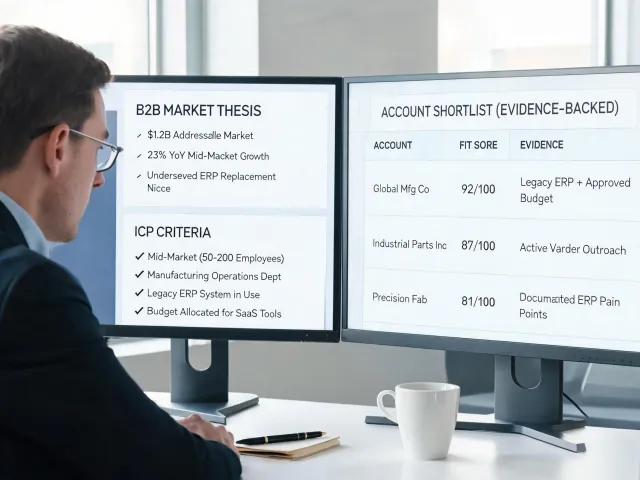
AI prospecting use cases arranged around an evidence review workspace

Use-case showcase

Salesloft adapts one evidence method to four revenue decisions

Prospecting constraints change by role, region, source, and channel. Each context below uses its own acceptance criteria rather than a universal list or benchmark.

Operating contexts

CRO reviewing market thesis evidence

Revenue leadership

CROs and founders can test a segment before adding seats. A useful trial compares accepted-account rate, reviewer time, provider cost, and downstream outcomes on a controlled set. It does not extrapolate a global accuracy promise from one territory.

SDR manager reviewing outreach controls

SDR operations

Managers separate list construction, contact verification, drafting, approval, and sending. Human review checks relevance, source recency, suppression, tone, CAN-SPAM, CASL, GDPR, and other obligations applicable to the team’s recipients.

GTM engineer tracing enrichment provenance

GTM engineering

RevOps and GTM engineers can compare single-source and waterfall enrichment. Multiple providers may increase field coverage while adding provenance, deduplication, rate-limit, cost, retention, and deletion complexity that must remain visible.

Outbound agency managing separated client research

Outbound agencies

Agencies can encode client-specific criteria and approved channels as reproducible tasks. Shared methodology does not remove the need to separate data, credentials, outputs, authorization, and suppression lists across accounts.

Four measures for every controlled trial

01 ICP acceptance Use a labeled test set
02 Evidence completeness Track source and retrieval context
03 Human review time Compare equal tasks
04 Deliverability outcomes Observe by domain and segment

These are evaluation dimensions, not performance claims. Verification does not guarantee inbox placement, replies, compliance, or commercial results.

A defensible trial freezes its ICP definition, labels a small reference set, records provider and runtime conditions, and reviews false positives as carefully as accepted accounts. Teams should preserve uncertain fields, measure the effect of source freshness, and document every human override before comparing one workflow with another. Repeat the method by territory because data availability, consent standards, and channel rules vary.


Test one use case with explicit evidence rules

Install the skill, define a narrow market question, and review the first sample before external action.

npx -y @okki-global/okki-go-taroball