-
The short version: personalization is not a step. It's a constraint on the whole agent loop.
-
Why trust me on this
-
Mistake #1: Personalizing the message instead of the decision
-
Mistake #2: Running personalization as a batch job
-
Mistake #3: Letting the agent personalize without human boundaries
-
What an agent-native prospecting workflow actually looks like
-
When this doesn't apply
-
Bottom line
The short version: personalization is not a step. It's a constraint on the whole agent loop.
If you're still treating AI personalization as a step — research first, then write, then send — you've already lost the argument about whether it belongs in an agent-native prospecting workflow. It doesn't belong in the workflow. It has to be a constraint that the workflow itself runs on.
Here's the thing: an AI SDR that personalizes after it decides who to email is a glorified mail merge. An AI SDR that personalizes as a variable inside the decision of who to email is a different product category.
That distinction cost me roughly $28,000 in wasted outbound budget between Q2 2023 and Q1 2024. I'm going to walk through what I got wrong, because if you're evaluating a sales engagement platform right now and you hear "we have AI personalization," you need to know which of those two products you're actually looking at.
Why trust me on this
I run outbound for a 14-person RevOps and SDR org. Since 2019 I've personally built or rebuilt six outbound stacks, migrated three times, and made the classic "we'll just bolt AI on top of our existing sequence" mistake twice. The second time cost $28K — not because the tool was bad, but because I configured the workflow wrong.
It took me two full quarters and about 14,000 touched contacts to understand that AI personalization and agent-native prospecting are not two features that play nicely together by default. They fight each other unless you wire them properly.
So here's what I actually learned, in order of how much it cost me.
Mistake #1: Personalizing the message instead of the decision
In my first year of doing this (2021), I made the classic customization error: assumed that "personalization" meant making the first line of the email look different from the last company I emailed. Cost me a lot of reply-rate experiments that went nowhere.
What I was actually doing was running a template with slots. The AI filled the slots. Insert {{company_name}}, insert {{recent_funding}}, insert {{hiring_signal}}. It looked personalized to a human skimming on a phone. It did not look personalized to a recipient who had already received four emails that week with the exact same structure.
Here's the thing that changed my mind: I pulled our reply data and cross-referenced it against message uniqueness. The messages with the most variable first lines had lower reply rates than a plain, direct, un-personalized email from a real human on my team. Because the personalization was cosmetic. It was dressing up a decision the agent had already made badly.
Real personalization inside an agent-native workflow is not about the message. It's about the targeting decision itself. If the agent decides to email a company because the enrichment says "they're hiring SDRs," and the personalization is just confirming that, you've built a loop that reinforces a low-quality signal. If the agent personalizes by saying "this contact just posted about a pain point your product solves, and here's the context where that pain shows up," that's a different loop entirely.
Look, I'm not saying cosmetic personalization is worthless. I'm saying it's the wrong layer.
Mistake #2: Running personalization as a batch job
Here's where the money really disappeared. In Q3 2023, we had a system where the workflow went like this:
- Pull 2,000 contacts from our prospecting tool.
- Run them through an enrichment pass.
- Run the enriched list through an AI personalization step.
- Push to the sequencer.
Do you see the problem?
By the time the personalized message hit the sequencer, the personalization was between four and eleven hours old. Intent signals decay. Funding announcements get covered by twelve other vendors. A hiring post from Monday is old news by Tuesday afternoon. We were sending extremely well-crafted, extremely stale emails.
We burned $11,400 in contacts that couldn't have converted no matter how good the copy was, because the underlying signal had already been picked up by five other SDR teams.
Here's what you need to know: in an agent-native prospecting workflow, personalization has to happen at the moment of decision, not in a queue. The agent should be able to look at a signal, evaluate the contact, generate the angle, and send — in one loop. If your workflow has a handoff between "enrichment" and "personalization" and "sending," you don't have an agent. You have a pipeline with three delays.
This is where I stopped evaluating sales engagement platform features as a checklist and started evaluating them as a latency problem. Which platform lets the agent decide and act in the tightest loop? That's the one that wins.
Mistake #3: Letting the agent personalize without human boundaries
This one is embarrassing, but I documented it so I'll share it.
After the batch disaster, I over-corrected. I gave the agent full autonomy on angle, tone, and reference points. In November 2023, we had a contact at a mid-market logistics company who had just posted a very grim update about layoffs. The agent, doing exactly what I told it to do, personalized an opening line that referenced "a challenging quarter" and pitched "efficiency gains."
The contact forwarded it to their VP of Sales. We did not get a meeting. We got a very polite, very firm no-contact request.
That single email, plus the residual brand damage in that segment, cost us a renewal cycle worth about $16K that we'd been tracking. Not a direct loss, but a real one.
What I learned: agent-native does not mean agent-unsupervised. We've caught 47 potential errors using a rewritten pre-send checklist over the last 11 months. The check isn't "does it look personalized." The check is: is the personalization relevant, timely, and safe to send from a human being with our name on the domain?
The good agents don't just generate. They flag. They route the borderline ones to a human. They have a bar for "this signal is too sensitive to automate around." If the platform you're configuring doesn't let you define that bar, you don't have an agent — you have a fire hydrant.
What an agent-native prospecting workflow actually looks like
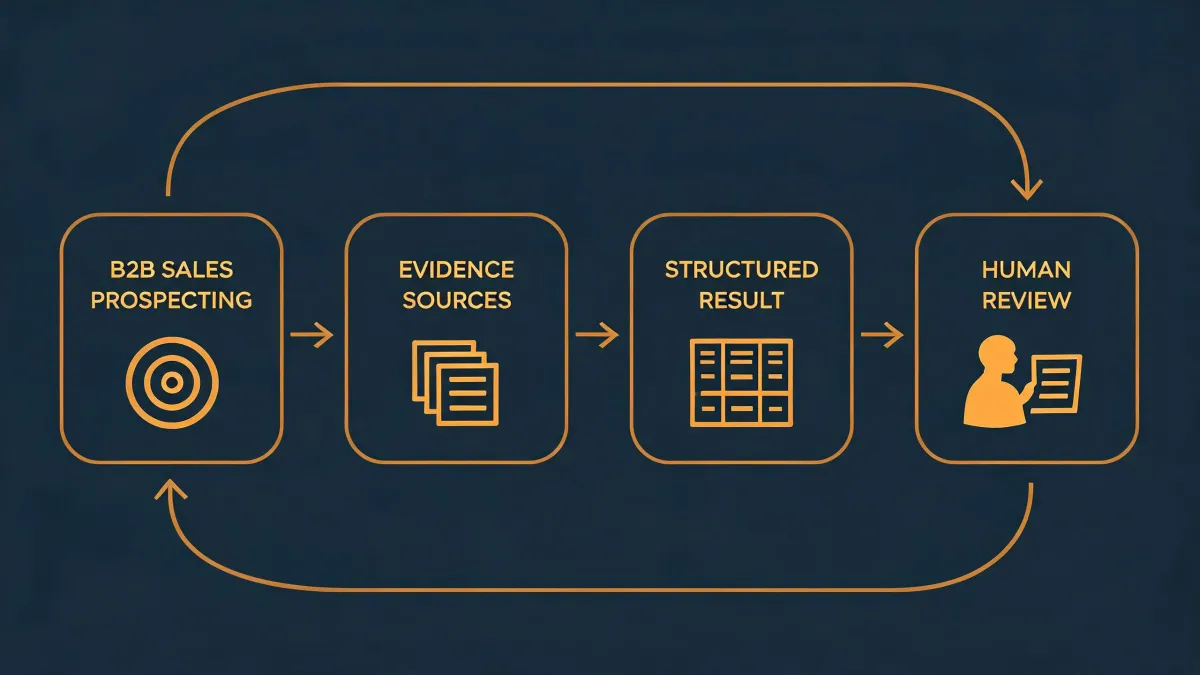
After the third rebuild, we landed on a workflow that looks roughly like this in practice:
- Signal ingestion (real-time, continuous). Intent data, hiring signals, LinkedIn activity, product signups — all flowing into the agent as a stream, not a batch.
- Waterfall enrichment on demand. Instead of enriching everything upfront, enrich the specific contact the agent is about to act on, using waterfall logic so we get the best available data without paying for redundant lookups.
- Personalization as a variable, not a stage. The agent decides who using the same context it will use to decide what to say. The two decisions are coupled by design.
- Human-in-the-loop routing. Sends above a certain sensitivity threshold, or to accounts above a certain value, get held for a human read. Not approval-gated — exception-gated.
- Feedback into the loop. Replies, bounces, unsubscribes, and meeting outcomes all feed back into the agent's signal weighting. This is the part most teams skip and then wonder why the agent gets worse over time.
That last point is the one that took me longest to understand. Personalization isn't a one-time configuration. It's a live variable, and it has to be fed.
When this doesn't apply
Honest boundary conditions, because I've watched this fail for other people too:
If your ICP is under 500 accounts and your average deal size is above $50K, don't automate personalization. The economics don't work. Have a human write every single email. The agent-native workflow is a volume-and-quality play; it doesn't replace high-touch enterprise outbound.
If your intent data is thin — like, if you're in a category where nobody writes about the problem publicly — the agent will make up personalization angles. That's worse than generic emails. Fix your data supply before you build the loop.
And if you're on a team of one or two SDRs, this full setup is overkill. You don't need waterfall enrichment and real-time signal ingestion. You need a spreadsheet and a strong opener. I've seen two-person teams beat enterprise stacks with exactly that.
The agent-native workflow pays off when you're running enough volume that a bad targeting decision repeats across hundreds of sends before anyone notices. Below that threshold, you are the agent. Act like it.
Bottom line
AI personalization doesn't slot into an agent-native prospecting workflow as a feature. It has to be the thing the workflow is thinking about the whole time — at signal intake, at targeting, at message generation, and at send decision. If you're buying based on a features list that has "personalization" as a bullet, you're probably buying the wrong thing.
Buy the loop. Configure the loop. Feed the loop. Everything else is a template with feelings.