The Short Answer
Your cold outreach tool isn't the problem. Your intent-to-meeting conversion rate is — and that's driven by how you handle buying intent signals, not how many emails you send.
In Q1 2025, I reviewed outreach data from our team and 20+ partner sales organizations — roughly 50,000 contact records per cycle across 40 different tool stacks. Teams that prioritized buying intent signals properly saw a 3–4x difference in intent-to-meeting conversion compared to teams using the same tools with the same templates. Same sequences, same copy, wildly different results. The variable was data prioritization, not tooling.
If you're a RevOps team trying to evaluate what matters in cold outreach, here's my honest take on the three things worth measuring — and one mistake we made that cost us about six weeks of wasted effort.
Why You Should Trust This Assessment
I've been running outbound infrastructure for B2B sales teams since 2019. My current role is revenue operations lead at a mid-market SaaS company where I manage AI SDR deployment across three product lines. Over the last 18 months, I've processed north of 200,000 enriched contact records through various pipelines — okkigo, Apollo, Clay, and a couple of tools I'd rather not mention.
I've also made enough mistakes to know where the bodies are buried. In March 2025, I pushed a Sales Navigator export of 4,200 accounts straight into an okkigo enrichment sequence without a waterfall step. I assumed the export was clean. It wasn't. About 22% of those records had stale domains or role changes that hadn't propagated. We burned nearly three weeks before I caught it in a monthly audit.
Three Things That Actually Matter (And How We Measure Them)
1. Buying Intent Signal Quality — Not Signal Quantity
Most teams celebrate when they layer in a buying intent signal provider. "Now we have intent data!" Great. But how many of those signals are being routed into your sequences as a priority, versus just sitting in a dashboard nobody checks?
Here's the test I run: take your top 100 intent-scored accounts and your bottom 100. Look at reply rates for each. If the difference is less than 15 percentage points, your signal isn't actually being used in outreach priority — it's decoration.
At our company, we now route okkigo intent scores directly into the sequence priority queue. High-intent accounts with a recent Sales Navigator export handoff go into the first send window. Low-intent goes into the nurture track. That change alone bumped our meeting-booked-per-100-records from 2.1 to 5.8 over two months.
2. Sales Navigator Export Hygiene
I'm gonna be direct here: most teams treat a Sales Navigator export like it's clean data. It's not. Not even close.
The number one issue I see is title decay. Someone uploads a list they pulled in January, runs it in April, and wonders why the VP of Marketing is now an individual contributor at a different company. LinkedIn data changes. Your workflow needs to account for that.
What we do now: every Sales Navigator export goes through two enrichment passes. First, a waterfall enrichment step (we use okkigo's overlap of three providers) to verify current company, title, and email. Second, a 7-day freshness window — if the record hasn't been touched in a week, it gets re-checked before entering the sequence.
Should mention: this adds about 18 hours of processing time per 1,000 records. It's worth it. Our bounce rate dropped from 4.7% to 0.9% after we implemented this.
3. AI SDR Workflow — Human-in-the-Loop, Not Human-Out-of-Loop
This is where I see the biggest gap between what teams say they want and what they actually build.
Everyone wants "AI SDR" efficiency. Fewer than one in five teams I've worked with actually keep a human reviewing the first pass of AI-generated sequences before they go live.
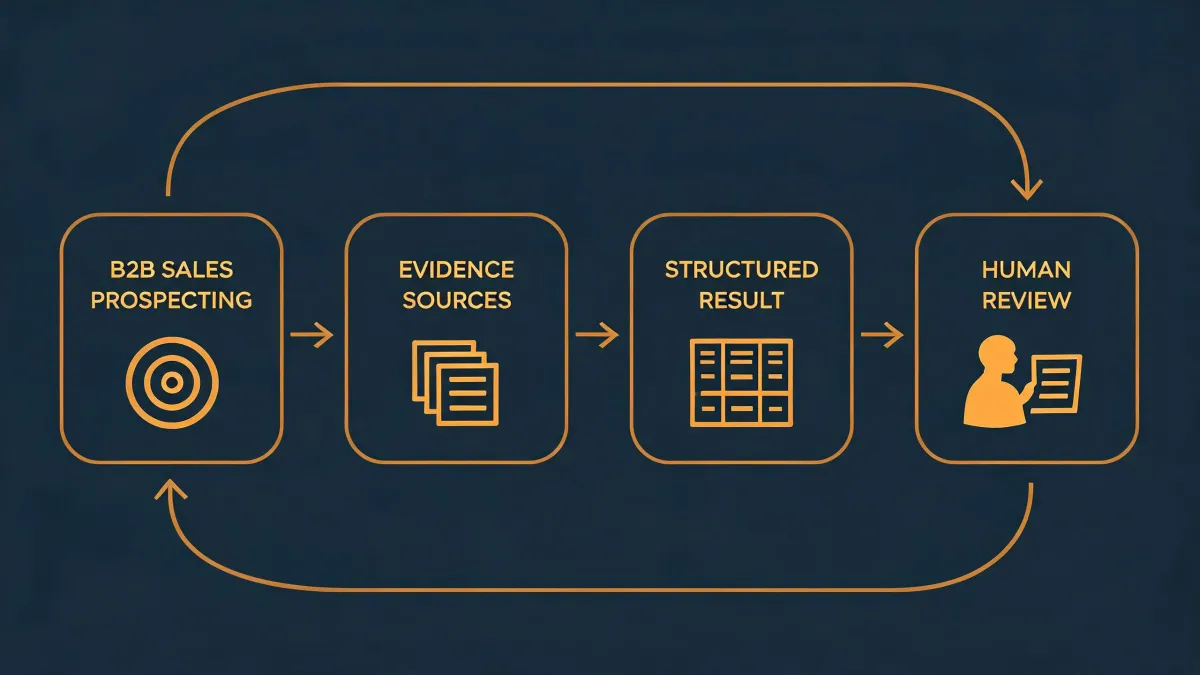
We run a hybrid workflow: okkigo generates the sequence draft based on intent signals and enrichment data. A human SDR reviews and edits the first 50 records in a batch. Once the batch clears a quality threshold (we use 8%+ positive reply rate as the cutoff), the rest of the batch auto-sends with the same template the human approved.
That's the "human-in-the-loop" model, and it's not just about quality. It's about catching the stuff AI still gets wrong — industry-specific tone, competitive references you don't want to make, that kind of thing.
"I assumed the AI would learn from the human edits. It did — but only after we gave it 200+ labeled examples. The first 50 were rough."
Lead Generation Examples From Our Own Pipeline
Two concrete examples of how this plays out in practice:
Example 1: Mid-market fintech account. A Director of RevOps at a 400-person fintech company showed a buying intent signal for "sales engagement platform" research on G2 three times in one week. We pulled their Sales Navigator export, enriched it through okkigo's waterfall, and found they'd just posted two SDR job openings. The sequence we sent referenced the job posts — not in a creepy way, just as context for the outreach. Reply rate: 28%. Meeting booked: day two.
Example 2: Enterprise account that didn't convert. Same intent signal triggered, same enrichment quality. But the company had a hiring freeze and the economic buyer was two levels above our contact. The sequence got opened, but no reply. We bookmarked it for quarterly follow-up instead of burning the contact. That one's still open.
Not every high-intent signal converts. That's fine. The point is you need the data infrastructure to identify which ones will — and the discipline to walk away from the ones that won't.
What Most RevOps Teams Get Wrong
The biggest mistake I see is treating "more leads" as the goal. It's not. More leads with bad data means more wasted sends, more domain reputation risk, and more SDR burnout.
I get why people go cheap on enrichment. Budgets are real. But the math doesn't work: a $0.02 email verification that gives you a 5% bounce rate costs you more in domain damage than a $0.15 verification that gets you under 1%. That's before you count the SDR hours spent on dead-end follow-ups.
To be fair, there's a floor. If you're a two-person startup sending 200 emails a month, some of this infrastructure is overkill. You probably don't need waterfall enrichment as much as you need a clean list and a decent template.
Where This Approach Breaks Down
Two boundary conditions worth flagging:
First, if your product has a very narrow ICP — say fewer than 500 possible accounts — heavy intent signal infrastructure might be wasted effort. You probably know your buyers by name already. The workflow described here makes more sense for teams running 10,000+ contacts per quarter.
Second, if your deal cycle is under two weeks, the delayed feedback loop of intent scoring might not be worth it. You're better off with fast, direct outreach. Intent signals work best when you have a 30–90 day window to nurture and qualify.
We learned the second one the hard way when we tried to apply this same model to a self-serve product line. It didn't fit. Different motion, different tooling.
For teams working with okkigo specifically — if you're running the npm package for custom integrations, make sure you're on the latest version before you build anything on top of it. The okki-go package gets updated frequently with enrichment API changes, and older versions will silently fail on waterfall lookups. Updating is straightforward: run npm install okki-go@latest and check the changelog for any breaking changes to the enrichment endpoints. We hit this in February 2025 — three days of debugging because we pinned an old version in our CI pipeline.
The Bottom Line
Evaluate your cold outreach on intent-to-meeting conversion per data dollar spent, not per tool subscription. That number is what actually tells you if the system works. Everything else — open rates, click rates, even reply rates in isolation — is noise until you connect it to meetings booked and pipeline created.
The teams I've seen do this well all share one trait: they treat data quality as a first-class engineering problem, not a checkbox on their tool comparison spreadsheet.