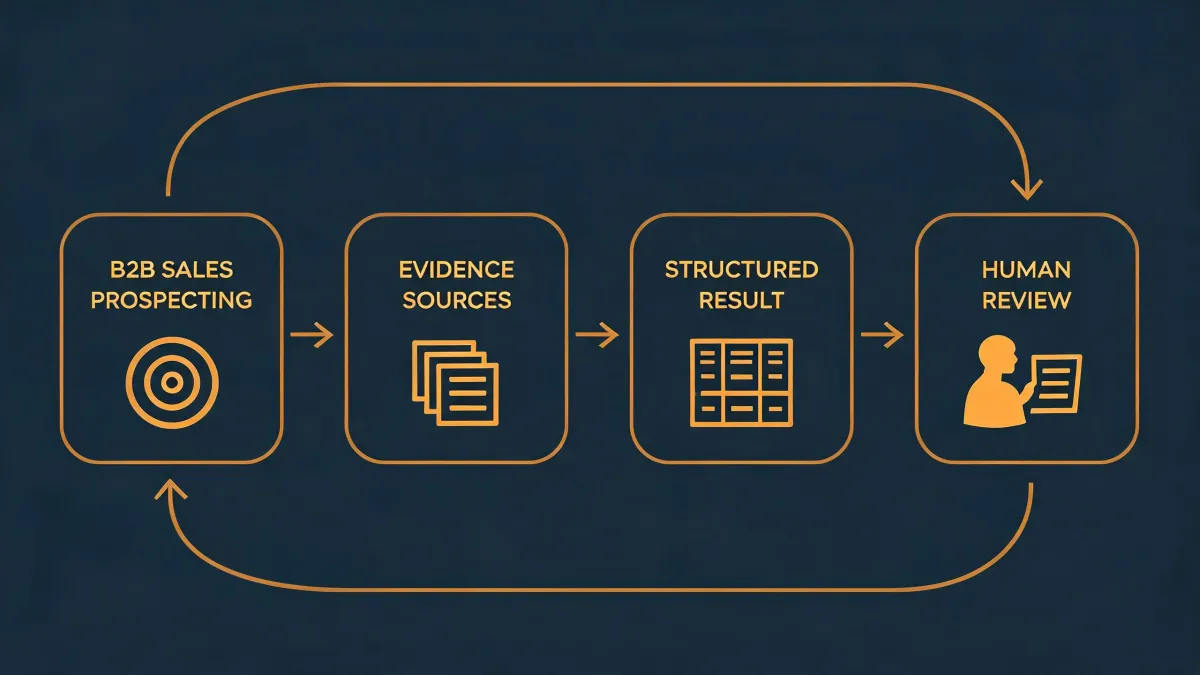
Two Approaches, One Question: Which Fits Your SDR Team?
If you're shopping for prospecting tools right now, you've probably noticed the market split in two sometime between 2023 and 2025. There's traditional lead generation software—big contact databases, basic verification, a few filters, and off you go. And then there's the newer category that vendors started calling agent-native prospecting: tools that don't just hand you a list, but try to run the workflow from list-build to first-touch, with you stepping in at the decision points.
I don't sell either. My job is to review outbound quality before anything leaves our building—cold emails, LinkedIn openers, contact lists, roughly 400 contacts a week. I rejected about 30% of first deliveries in 2024, for reasons ranging from “plausible-looking but unverifiable” emails to “intent signal dated three months ago.” I've been burned by both categories. Here's how I'd compare them, dimension by dimension, based on what actually moves needle on reply rates and domain reputation.
First, my lens: total cost of ownership, not sticker price
Every time our team compares lead generation software, procurement leads with a pricing sheet. Convenient. Also, kind of misleading. The per-contact price and the per-seat price both matter, but they don't tell you what it costs to touch a contact once. Every hour a SDR spends deduplicating a CSV is a sunk cost. Every bounce that drags your sending domain reputation down is a cost that shows up weeks later, in lost deliverability you can't easily claw back. I learned this the expensive way—more on that below. So both dimensions that follow are scored on total cost, not the invoice.
Dimension 1: Email Verification—If This Is Weak, Nothing Else Matters
Traditional route: you filter a database, hit “verify,” export, and start sending. Sounds fine. The problem is what that verification step actually does. Most cheap verifiers are doing an SMTP handshake and a blacklist check. They catch the obvious dead addresses. They don't catch the suspicious ones.
Agent-native route (what okki-go email verification does, concretely): verification is inside the workflow, not a bolt-on step you run after. Every contact gets checked before it enters the outreach queue—syntax, domain, MX, catch-all detection, and a recency signal on activity—and it gets flagged, not just dropped into a silent bounce. The scoring is different. Suspicious addresses get treated as suspicious by default. Your SDR doesn't have to do triage on “maybe-valid” addresses anymore.
Everything I'd read about lead gen said bigger data means bigger coverage. In practice, for a 3-person SDR pod, a 200,000-record database filtered down to 8,000 high-confidence contacts beat a much larger, noisier list every time we tested it. There's a reason: your inbox provider doesn't care how big your list is. It cares how many people actually want your email. That one shift alone cut our bounce rate enough that our warmed domains stopped resetting.
“Verification isn't a step. It's a gate. If it lives downstream of anything, it's not verification—it's hope.”
One honest caveat: no verifier is perfect, including this one. Catch-all domains still exist, and any vendor promising 100% accuracy on them is telling you something about their sales team, not their tech.
Dimension 2: Workflow—Who Actually Does the Work?
This is where the two approaches genuinely part ways, and it's the comparison that surprised me most.
With traditional lead generation software, the workflow owner is you. The tool gives you enriched rows and a filter UI. What happens next—sequencing, timing, replies, routing, iteration—is your team's problem. There's nothing wrong with that. Plenty of teams run fine this way. But every extra step is a place where things quietly break. Every handoff is a chance for a lead to fall through.
With agent-native prospecting, the workflow is partly owned by the product. Contacts flow into a queue, an agent handles the verification, the enrichment, the sequencing, and pages a human back in only where a decision is genuinely needed—replies that need classification, objections that don't map to a playbook, account-level judgment calls. That's what okki-go's workflow for SDR teams looks like in practice: the agent does the doing, the human does the deciding.
Or put it another way: it's not about replacing SDRs. It's about not paying a SDR $70k a year to babysit a spreadsheet.
But—and this is the part I'd want a buyer to hear—agent-native doesn't mean “set it and forget it.” If someone tells you that, walk away. You need to define rules. It took us two weeks to get the suppression lists, sending-domain rotation, and pacing rules right. Honestly, this class of tool is worse than manual when it's misconfigured, because it's faster. Faster means wrong at scale.
Dimension 3: Enrichment, Intent, and the Human-in-the-Loop Question
Traditional software gives you static enrichment—title, company size, industry. Useful, but in 2026 it's table stakes. Intent signals, when traditional tools have them, are usually an add-on SKU with its own contract.
Agent-native puts both inside the workflow. Waterfall enrichment (multiple providers queried in sequence until a match lands) plus intent signals that decay over time—funding events, hiring posts, tech stack changes. Then the crucial part: a decision point, not an automatic send. okki-go calls their approach “human-in-the-loop outreach,” which sounds fancy, but the actual experience is this. You get a card in your inbox: here's the contact, here's what I found, here's the suggested opener. You approve, edit, or kill it. That pacing is what keeps the workflow fast without letting it fly off the rails.
The event that changed how I think about “fully automated” outbound was a bounced campaign in September 2023 that cost us the one revenue goal we had set for the month. A batch sequence went out from a mailbox nobody had logged into in three weeks. The data was technically clean. The workflow had nobody watching it. Twelve minutes of human verification would have saved a full week of pipeline. Ever since, I treat “send automatically” as a red flag, regardless of vendor.
So Which One Should You Buy?
There's no universal answer, and honestly the sticker-versus-total-cost thing cuts both ways here. Depends on where you are:
- Choose traditional lead generation software if you already have SDRs running a disciplined sequence and your real gap is raw data. Add verification. Add discipline. It can work well for that use case.
- Choose agent-native prospecting if you're carrying the workflow on your own back—if your SDRs spend half their day building lists and verifying emails, or if you've had a data quality incident that hurt your sending reputation. This is the scenario where agent-native earns its keep.
- Use both if you've got five to fifteen SDRs. Contract with a traditional provider for the data layer, run an agent-native tool on top of it for the workflow layer. It's a real expense, and you'll need to think about deduplication between the two, but it's how several of the teams I've compared notes with actually operate.
What I'd avoid: anything promising to do everything for everyone. Nothing does. Compare the total cost—bounces, wasted SDR hours, and deliverability damage included—and pick the approach that removes the bottleneck you actually have.
If you're already sending to 400+ contacts a week, you probably know from your bounce rate alone which side you belong on. (Note to self: stop re-importing that legacy CSV file. It has never once been a good idea.)