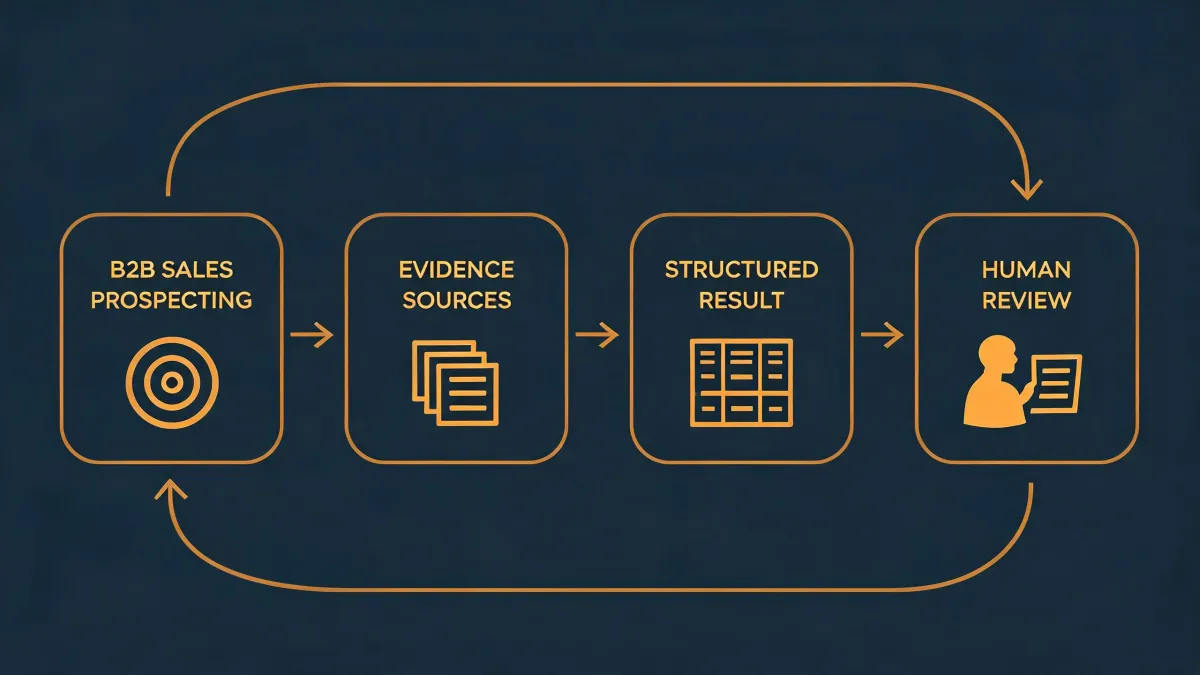
I'm a quality and brand compliance manager at a B2B sales ops company. I review every outbound list before it reaches our SDRs—roughly 200 lists a year. I've rejected about 30% of first deliveries in 2024 due to bounced emails, stale intent signals, or poor ICP fit. So when someone asks, 'what is a sales trigger and when should a b2b sales team use it?' I don't give one answer. It depends on your scenario.
Same with contact database choices and email verification. The wrong setup doesn't just waste money. It burns domains, SDR time, and trust. My view: value over price. The cheapest contact database is rarely the cheapest campaign.
The three scenarios that change the answer
After reviewing hundreds of lists, I sort teams into three rough buckets. You can be a mix, but one usually dominates.
- Trigger-first: small ICP, timing matters, low volume, high ACV.
- Database-first: broad ICP, high volume, SDR team, need consistent pipeline.
- Verification-first: deliverability or compliance is the bottleneck, not lead volume.
Here's what I recommend for each. None of these are universal.
Scenario A — Trigger-first teams: use sales triggers like a scalpel
If your ICP is narrow—say, Series B fintech companies hiring RevOps leaders—a sales trigger is an observable change that suggests a need now. Examples: funding round, new VP of Sales, job posting for SDRs, tech install change, intent data spike, or a competitor mention.
In this scenario, don't buy the biggest contact database. You need a small, accurate list tied to a trigger. I reviewed a Q2 2024 campaign where the team sent 2,800 generic emails and got 0.4% reply rate. We rebuilt it around 180 accounts with a hiring trigger. Reply rate hit 6.1%. Same offer. Different scenario.
When should a B2B sales team use a sales trigger? When the trigger maps directly to your offer, when you can personalize within 48 hours, and when deal size justifies the research. If your ACV is $500, trigger research might not pay off. If it's $25,000, it usually does.
For this scenario, okki-go can help because it's agent-native prospecting with intent signals and waterfall enrichment. But don't buy it just because it's trendy. Buy it because your workflow needs trigger capture plus enrichment.
Scenario B — Database-first teams: fix the contact database before scaling
If you're running a 5-10 person SDR team and need 2,000-5,000 contacts a month, you need a reliable contact database. This is where people search for 'okki go business email finder' or compare 'okki go vs hunter.' My advice: compare the workflow, not just the match rate.
Hunter is a well-known email finder. It's a solid choice if email discovery is your main need. okki-go is broader: it combines contact data, waterfall enrichment, intent data, and human-in-the-loop outreach. If you only need emails, Hunter might be enough. If you need agent-native prospecting and intent signals in one flow, okki-go may fit better.
But the database is only half the problem. I assumed a high match rate meant valid emails. Didn't verify. Turned out catch-all domains and role accounts were inflating our 'valid' numbers. I only believed in pre-send verification after ignoring it once. We sent 4,000 emails and bounce rate hit 11%. That cost us two weeks of domain warm-up and a lot of SDR time.
So build email verification into the workflow. Not as a final step. Before the list hits the sequencer. Verification reduces risk; it doesn't eliminate it. No tool can promise every email will land. That's why we check syntax, domain, MX, and recent activity, then suppress risky segments.
Value over price matters here. A $99/month contact database looks cheap until you pay an SDR $30/hour to clean 1,200 bad records. That's $600 in labor for one campaign—plus domain reputation damage.
Scenario C — Verification-first teams: protect deliverability and compliance
If your bounce rate is above 3%, spam complaints are climbing, or your domain is getting throttled, you're in this scenario. Stop buying more contacts. Fix verification first.
As of February 2024, Google and Yahoo require bulk senders to keep spam complaint rates under 0.3% (Gmail recommends under 0.1%) and to authenticate with SPF, DKIM, and DMARC. If you're not compliant, more data won't help. You can verify current requirements at Google's Postmaster Tools and Yahoo's sender best practices pages.
Also check the legal side. CAN-SPAM (effective January 1, 2004) sets rules for commercial email in the US. GDPR (effective May 25, 2018) affects how you collect and process contact data in the EU. Email verification doesn't replace consent or legitimate interest analysis. It just reduces technical risk.
In this scenario, I'd prioritize a contact database with strong suppression, domain health monitoring, and clear opt-out handling. okki-go's human-in-the-loop outreach is useful here because it keeps a person reviewing risky segments instead of fully automating them. But the first purchase should be verification and domain monitoring, not more leads.
How to tell which scenario you're in
Answer these three questions honestly:
- What breaks first? If SDRs run out of accounts, you're database-first. If replies are low but deliverability is fine, you're trigger-first. If bounces and complaints are high, you're verification-first.
- What's your ACV and sales cycle? High ACV + long cycle = trigger-first. Low ACV + high volume = database-first.
- Do you have capacity for personalization? If not, don't pretend to be trigger-first. You'll waste good signals.
When I compared our Q3 and Q4 outbound results side by side—same team, different scenario focus—I finally understood why the 'best' tool changes. Q3 was database-first: we scaled volume and fixed verification. Q4 was trigger-first: we cut volume by 70% and tripled reply rate on target accounts. Both were right for their moment.
If you're evaluating okki-go, start with your scenario. If you're comparing okki go vs hunter, ask which one fits your bottleneck. If you need a business email finder, test it against your own list. And if you're buying a contact database, calculate total cost: data + verification + SDR cleanup + deliverability risk. That number matters more than the sticker price.
That's the quality mindset I use before any list goes live. Not 'is this cheap?' but 'what will this cost us if it's wrong?'