-
What should revenue operations teams evaluate in lead generation features?
-
Why OKKI Go outbound research matters more than database size
-
The intent data dashboard should be the beginning of the conversation
-
Managed email deliverability is a process, not a checkbox
-
Checking OKKI Go privacy and data-use claims
-
The objection: do you even need an AI SDR tool?
-
Judge the workflow, not just the demo
Every time a sales or RevOps teammate asks me to look at another lead generation tool, I can predict the first four questions: How much does it cost? How many credits? Does it have LinkedIn automation? Is there a free trial? They don't ask the questions that actually decide whether the tool survives after the first quarter.
I know this angle isn't typical for a vendor article. I'm not an SDR or a head of RevOps. My title is office administrator, and in practice I manage the sales tooling budget and renewals for a B2B company of about 200 people. I took over purchasing in 2021 and I've processed somewhere between 60 and 80 SaaS orders every year since then. I also helped with our 2024 vendor consolidation project, where we cut roughly 14 sales-related subscriptions down to nine. My job is not to be charmed by a product demo. My job is to notice the issues that make internal customers stop using something after the novelty wears off. That's the perspective I'm bringing to OKKI Go.
Here is the argument I want to make: Most RevOps teams evaluate the wrong layer of lead generation features. They compare feature lists and miss the operational features underneath those lists. OKKI Go is a useful case study, so let me walk through what I looked at during our review and what I'd advise any revenue operations team to evaluate before buying.
What should revenue operations teams evaluate in lead generation features?
The exact question our team put in front of me was: What should revenue operations teams evaluate in lead generation features? Not just OKKI Go features, but the core evaluation criteria. The obvious answer is contact search, email verification, enrichment, and LinkedIn automation. The problem is that everyone has those features now. Feature grids are not a real differentiator. The evaluation needs to go one layer deeper.
When I evaluate a tool, I ask what happens after a lead is created. Many lead generation tools look great at the search stage and fall apart at the handoff stage. The list goes to an SDR who has no context, the data goes stale, and the CRM gets polluted. That isn't just a tooling problem; it's an evaluation problem. You have to judge output and workflow, not just the input feature set.
Why OKKI Go outbound research matters more than database size
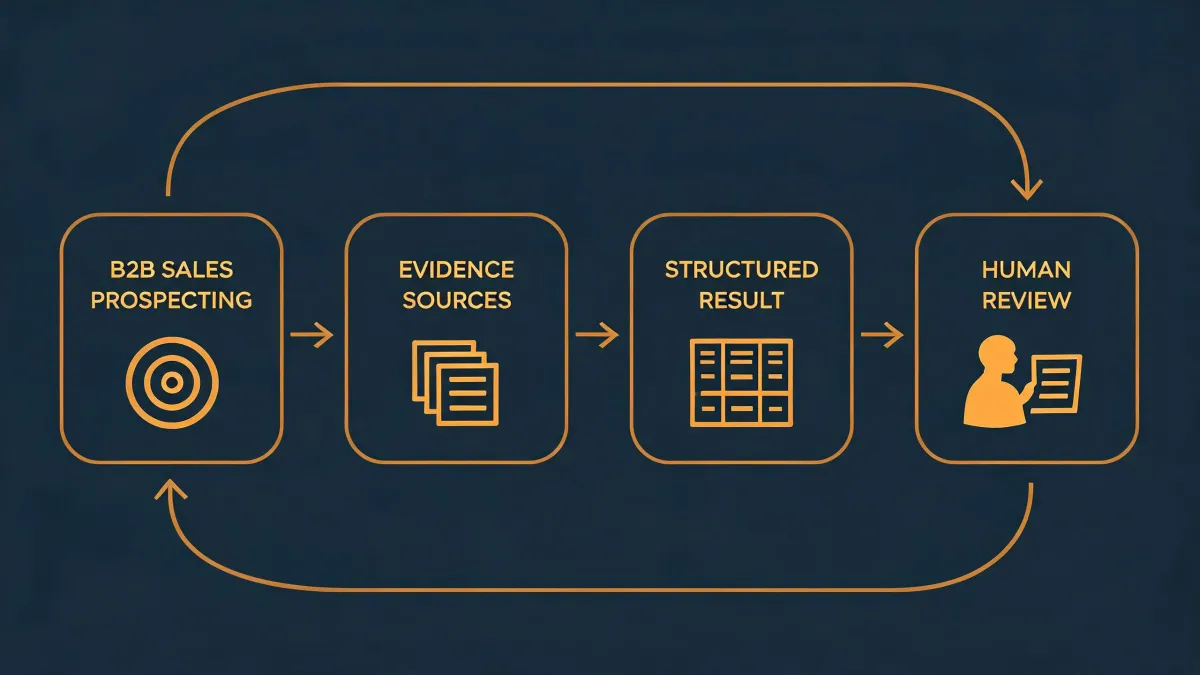
I'll use OKKI Go as an example because its positioning includes agent-native prospecting. But that phrase only means something when you watch how the agent works. In the OKKI Go outbound research flow, the tool builds a research file for a person or account before your SDR starts outreach. It looks for signals, recent news, job changes, growth events, tech stack clues, and other context. That research gets attached to the workflow and can be reviewed before the message goes out.
This is the part I would tell any RevOps team to evaluate first. Does the tool simply generate a list, or does it prepare your team to have a real conversation? If a rep needs five or six tabs open just to understand why a prospect should care, you are still doing manual research. If the tool does the digging and the human does the judgment, that's an actual workflow improvement.
The intent data dashboard should be the beginning of the conversation
The intent data dashboard is the first thing people ask to see. I understand why. A polished dashboard makes data feel trustworthy. But a dashboard is just a picture of an underlying process, and the underlying process is what you're actually buying.
Most buyers focus on which accounts are showing intent and completely miss how the tool defines intent. The question everyone asks is, is this account in market? The better question is, what made the algorithm say that? Search intent and browsing intent are not the same. One data vendor's intent might mean content syndication clicks; another's could mean engagement across a network. If you don't know which type you're buying, you can't tell if it's working.
During our evaluation, I wanted to know how often the intent data is refreshed and whether the source is transparent. If you act on intent signals that are six weeks old, you might be calling a company that already chose a solution. The dashboard is useful, but it's not the feature. The source and the freshness are the feature.
Managed email deliverability is a process, not a checkbox
The term managed email deliverability sounds reassuring. I'd rather define it. When a vendor says deliverability is managed, I ask who monitors it. Is there a person or system watching domain reputation, bounce reasons, spam complaints, and blacklist status? If a domain starts getting flagged, does outreach pause automatically? Does the product verify email addresses before a campaign starts? These are not nice-to-have details. They are lead generation features that determine whether your outbound domain stays alive.
For OKKI Go, the managed email deliverability conversation focused less on sending more and more volume and more on sending hygiene: verifying contacts, watching complaints, and adjusting before reputation degrades. That's the right way to frame it. Anyone who promises guaranteed reply rates or 100 percent deliverability is not giving you an actual plan. They're giving you a sales line.
Checking OKKI Go privacy and data-use claims
Go ahead and search for okki go privacy before you sign up. I'd encourage every RevOps team to make that part of the evaluation process. Privacy and compliance should be treated as functional requirements, not legal extras.
Per FTC guidelines (ftc.gov), marketing claims need to be truthful, not misleading, and substantiated. I used that as my baseline before looking at OKKI Go's privacy policy and data processing approach. The important questions were simple. What contact data is collected? Where does it come from? Can prospects opt out? What happens to data after the contract ends? No privacy page answers everything, but a vendor should be able to answer those questions directly.
The objection: do you even need an AI SDR tool?
To be fair, manual, in-house prospecting still works. If you're going after twenty named accounts with a small team, a spreadsheet and good research habits may be enough. Tools like OKKI Go become valuable when you need repeatable outbound volume without losing context and control.
I'm also not saying OKKI Go replaces a human SDR. The human-in-the-loop parts matter. Research still needs review. Outreach still needs judgment. Personalization still needs a person who understands the prospect. The tool gives your team leverage; it doesn't remove the need for skilled operators.
In 2021, a different team at our company bought a prospecting tool before assigning a workflow owner. The review process looked great. Within seven months, only three power users were touching it, and I was the person cancelling the subscription. New software doesn't fix an undefined process. That's why my answer isn't just go buy OKKI Go today. My answer is evaluate OKKI Go the way you should evaluate every serious tool.
Judge the workflow, not just the demo
As of Q1 2026, this is where my view landed. OKKI Go made sense for us because it matched the workflow our SDRs already wanted: outbound research with context, an intent data dashboard that makes signals inspectable, managed email deliverability with someone actually paying attention, and privacy practices that don't feel like an afterthought.
The question what should revenue operations teams evaluate in lead generation features has a clear answer in my mind. Evaluate deliverability operations, data transparency, research depth, workflow fit, and privacy compliance. If a vendor says agent-native, ask whether the agent's output can be reviewed by a human. If a vendor shows you an intent data dashboard, ask what data is behind it. If a vendor says managed deliverability, ask who watches the sending reputation when the campaign is live. That's where the real product lives.
OKKI Go passed that review for us. The actual decision still depends on your team size, your ICP, and your process maturity. But if you only compare feature lists, you're not comparing the tools at all.