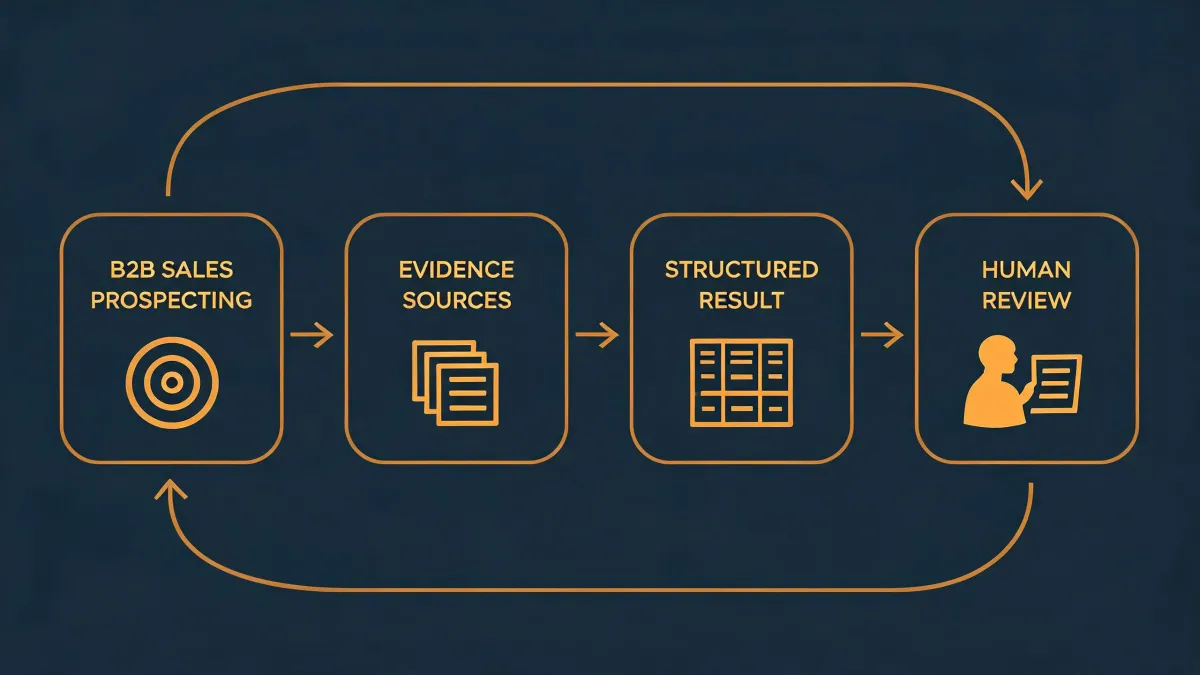
I've been managing procurement for B2B sales and GTM teams for six years. Over that time, “the email finder has bad data” has to be one of the most common complaints I hear. It's also one of the least accurate.
What it usually means is that a team is pointing a perfectly good email finder at a deeply flawed prospecting process. I've audited enough contracts now—somewhere north of 30, give or take—to see the same pattern again and again. And once I realized that, it changed how I evaluate every sales intelligence tool, including the Okki Go vs Clay debate that keeps showing up in my review meetings.
The complaint that started it
Our SDR manager wanted to cancel the email finder contract and switch vendors. The data quality was bad, he said. Emails were bouncing. Reply rates felt worse than last quarter. But before I signed off on a new contract, I did what I've learned to do: I pulled the usage logs, the exports, and the invoices.
The finder was performing exactly as promised. I thought we were paying $4,800 a year for that contract. In reality it was $3,600—I was mixing it up with the enrichment renewal. That's the kind of error I would have made three years ago, before I started documenting everything.
So the data accuracy was within the vendor's stated range. The real problem only showed up when I opened the actual lead list. Almost half the contacts the SDR team had exported that quarter were outside our company's own ideal customer profile. I don't mean slightly outside. I mean the wrong company size, wrong industries, no purchase signal, no intent. We were paying a good tool to find emails of people we should never have been contacting in the first place.
The first thing I check now: is the ICP real?
Early in my career, I assumed “better data” meant a better vendor. If emails bounced, the tool was broken. Simple. It took getting burned on a couple of cheap lists and one very expensive renewal to learn the hierarchy that actually matters: targeting first, workflow second, data third.
Here's what you need to know: no email finder fixes a fuzzy ideal customer profile. If your team can't describe the ICP in a way that translates into filters—industry, company size, role, the trigger events that mean someone is actually buying—then every prospecting tool you buy is just subsidizing bad targeting.
Put another way: a tool that finds 1,000 emails for people who don't fit your ICP hasn't found you 1,000 leads. It has found you 1,000 ways to waste your SDR team's time.
The hidden cost in the Okki Go vs Clay comparison
The Okki Go vs Clay question comes up a lot in my audits now, and I think the usual comparison misses the biggest line item. Both platforms can pull data, enrich records, and help you build lists. But the two products make very different assumptions about who's going to operate them.
Let me say this clearly: Clay is a genuinely powerful platform. I've seen teams do impressive things with it, and if you have a skilled RevOps person who enjoys building complex workflows, that modular approach can compound in value. The catch is that “if you have a skilled RevOps person” is doing a lot of work in that sentence.
For a 50-person company without a full-time RevOps hire, the operator is usually an AE or a founder who promised to “set it up” and is now debugging an integration at 9 p.m. instead of selling. That labor never appears on a vendor invoice. But it shows up in pipeline.
Okki Go approaches the problem from the opposite direction. It's agent-native: the AI agent handles the workflow—waterfall enrichment when one source comes up empty, layering in intent data, list building, even the first draft of outreach. A human stays in the loop for approvals, so nothing goes out without judgment. But no one is spending their evenings maintaining tables.
I have mixed feelings about AI agents, honestly. Part of me thinks they're overhyped. Another part has seen the operational chaos they can remove. For a procurement decision, though, the relevant question is a total cost of ownership question: are you buying a tool that needs a specialist operator, or are you buying a system that does the operational work for you?
If you're asking whether Okki Go is a Clay replacement, my answer is: it depends on who would be running the Clay workflow. If that person exists and has capacity, buy the building blocks. If not, the Okki Go AI agent integration tends to be the more predictable cost.
“Found” is not “verified.” And neither means “safe to send.”
There's another layer that confuses a lot of B2B teams: the difference between finding an email, verifying it, and being confident it's safe to send to.
An email address finder is a lookup utility. You give it a name or a domain, and it returns addresses pulled from public sources, patterns, and best guesses. Some results are highly accurate. Some are guesses dressed up as data.
A verifier is a separate function. It checks whether an address is syntactically valid, whether the domain accepts mail, whether a mailbox actually exists. But even a “verified” address can land in spam. And verification quality varies significantly between tools. When I audit sales intelligence features, I ask what a vendor means by “verified” and what happens when the system can't confirm a record. Does it say “unknown,” or does it silently serve up a guess?
That's where waterfall enrichment matters. Okki Go's approach—checking one data source, then falling through to the next when a record can't be confirmed—is the kind of feature that doesn't look exciting in a comparison chart but saves you money in practice. A good system tells you when it doesn't know. A bad one hides the uncertainty.
What a mistake costs at the wrong moment
You can't verify everything in advance. Data decays, people change jobs, companies change stack. But the cost of a mistake changes dramatically depending on when you discover it.
In March 2024, we paid a premium for a shorter, cleaner, verified list rather than using a cheaper but larger list from a discount provider. The cheaper option probably would have delivered—maybe. And “maybe” was the problem. We were working against a deadline for a major outbound campaign, and there wasn't time to recover from a bad first send. The premium wasn't about buying speed. It was about buying certainty.
This is the principle I keep repeating in budget meetings: an uncertain cheap option is more expensive than a certain option that costs more. Especially in Q4, when you don't have three extra weeks to discover the list was bad.
There's also a compliance angle worth flagging. Per FTC guidance (ftc.gov), commercial email needs to include honest header information, a clear way to opt out, and a physical postal address. If you're buying lists or using finders that pull questionable data, make sure your sending infrastructure can honor those requirements. Verify current rules at ftc.gov before you scale anything.
So when should a B2B sales team use an email finder?
Use one when you have a specific, ICP-aligned target list and you need to turn “I know this is the right account” into “I know the right person at that account.” That's the sweet spot.
Don't use an email finder as a substitute for strategy. If your team hasn't agreed on who to sell to, or if you're not prepared to run verification, enrichment, and proper outreach on top of it, a finder is just a way to generate bounces faster.
Here's the short version of what I'd put in any procurement checklist:
- Define the ICP first. One sentence. If your team can't agree on it, no tool will help.
- Ask who operates the platform. If it's an AE at 9 p.m., choose agent-native. If it's a dedicated RevOps person, modular tools are a legitimate option.
- Look for verification and waterfall enrichment. A sales intelligence platform that can't tell you when it's guessing is a liability.
- Insist on human-in-the-loop outreach. AI can draft and research. A person needs to own the final message.
I still don't believe in “100% accurate” email verification. Anyone selling that is selling marketing, not data. But I do believe in paying for certainty when the moment matters. That's not an upsell. That's risk management.
Get the ICP right. Choose the platform based on who'll run it. Verify before you send. Do those three things and the “best email finder” question largely answers itself.