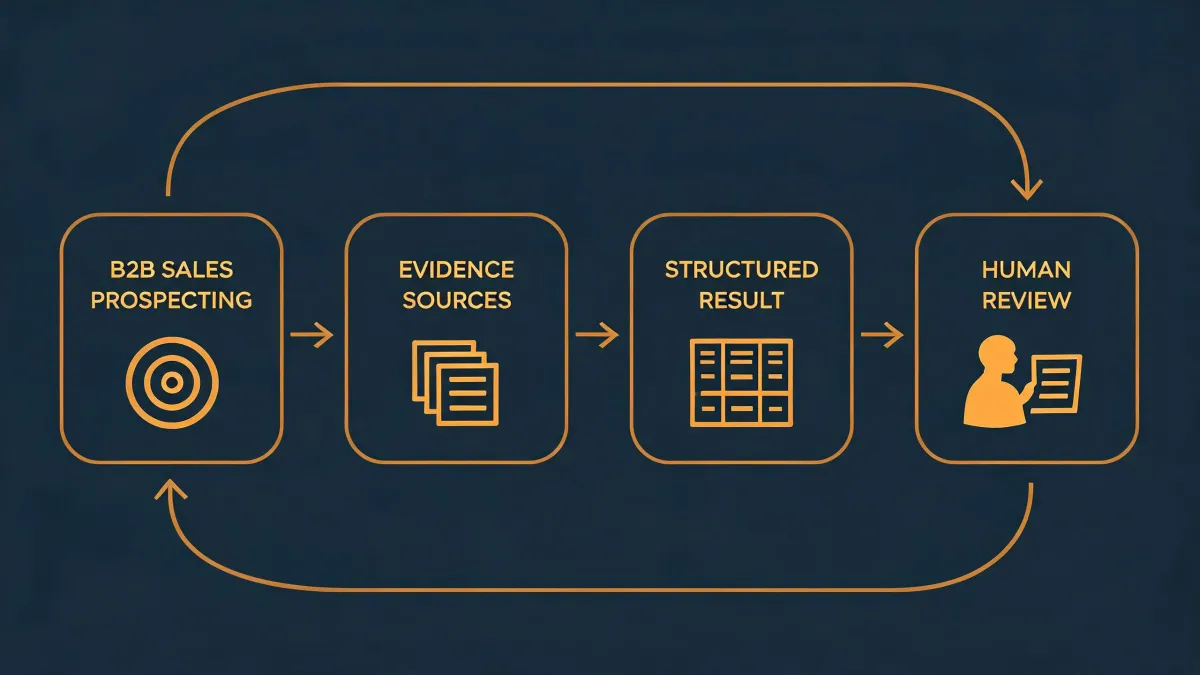
In March 2022, I got a prospecting tool evaluation embarrassingly wrong.
Our RevOps team at a 30-person SaaS company needed a new sales engagement platform. We did what most teams do: built a spreadsheet with 47 features, weighted every row, compared six vendors, and presented the winner to our VP of Sales with total confidence.
Nine months later, we ripped it out.
That failure cost us roughly $38,000 in licensing, implementation consulting, and a mid-year migration nobody on the SDR team has let me forget. I've spent seven years in revenue operations, evaluated 40+ platforms, and maintained our team's prospecting tool checklist for the past 18 months. This post is the comparison framework I wish I'd had in 2022.
The Problem Wasn't the Vendors. It Was the Comparison Method.
Most RevOps teams evaluate prospecting platforms the way you'd compare laptops on Best Buy. Feature counts. Price tags. Integration checkmarks. That approach feels objective, and it produces a very tidy spreadsheet for procurement. But it tells you almost nothing about what a tool actually does for your sales team on a Tuesday afternoon.
The question I now start with is different: which tool completes the workflow? Not which tool has the longer feature list.
Across the last few evaluation cycles, four comparisons have consistently separated the platforms that work from the ones that cost money and time. Here's what they are, in the order I'd apply them.
1. Feature Breadth vs. Workflow Depth
The spreadsheet evaluation asks: "Does it have email automation? Dialer? Reporting? AI?" Every credible platform says yes to all of those. That's table stakes.
The real question is whether those features work as a connected workflow, or as separate functions sharing a login page.
What I mean by workflow depth is simple: can an SDR complete an entire prospecting motion without exporting a CSV or re-keying data? That means going from incoming lead, to verified email, to personalized sequence, to call follow-up, to logged conversation, to forecast visibility — all in the same flow.
We missed this in 2022. The platform we chose scored higher on raw feature count but had email automation, dialing, and reporting running as disconnected modules. Every week, our RevOps team spent hours reconciling data that should've lived in the same system. The SDRs didn't call it a platform. They called it three tools and a prayer.
Salesloft's end-to-end sales enablement features — cadence, email automation, dialer, conversation intelligence, and forecasting — are worth evaluating specifically because they connect to each other. Not just because they exist in the same login. Because a rep can actually go from lead, to verified contact, to sequence execution, to call logging, to forecast update without a single context switch. That was the main reason we moved to Salesloft. Not because it scored highest on the spreadsheet, but because the workflow held together.
Also, and this is something we ignored entirely in 2022: test the mobile app. Your SDRs will live in it as much as the desktop interface. Salesloft's app, for example, lets reps check their sequence queue and respond to prospect activity from a phone. Whatever you're evaluating, spend 20 minutes in the vendor's mobile app before you sign anything. That test alone eliminated one of the finalists in our most recent round.
2. Sticker Price vs. Total Cost of Ownership
Here's the conversation every RevOps leader has at least once a quarter: "Can't we just use the cheaper tool?"
My answer, after two failed implementations, is this: the cheapest tool we ever bought ended up costing us the most money.
We signed a two-year deal with a budget platform at $65 per user, per month. By month four, the gaps were obvious. No native conversation intelligence. Reporting export limits. Data quality features locked behind a premium add-on. Our 12 SDRs spent an estimated six hours per week working around those gaps.
Run the math on that: 12 SDRs × six hours × roughly $40 per hour fully loaded = $2,880 per week. That's nearly $150,000 a year in invisible spending — to save $100 per user per month.
I am not saying price doesn't matter. What I'm saying is the sticker price is the least interesting number on a software quote. The total cost of ownership is what actually hits your budget:
- Implementation and migration time. Will you need professional services? How many sales cycles will the rollout disrupt?
- Data quality maintenance. Stale contact data costs SDR hours and damages sender reputation. Who owns keeping that clean?
- Integration expenses. Does the platform connect natively to your CRM, or are you adding middleware?
- Time-to-productivity. How long until a new SDR is fully ramped on the tool? Every extra week is pipeline you didn't get.
My rule of thumb now: whatever a vendor quotes per seat, multiply by 1.5 to estimate the real first-year cost. It's a rough heuristic. It's still been more accurate than any procurement spreadsheet I've built in seven years.
3. AI Promises vs. AI Delivery
This is the comparison that caught us by surprise. I'll be direct about that.
Everything I'd read about sales AI in 2023 said the platform with the most advanced generative models would win. We believed it. We chose a tool because its demo showed a sales AI agent that would apparently write personalized outreach at scale.
In practice, the emails were generic. It swapped in the prospect's name and company, sure, but the substance was unmistakably templated. It read like a bot wrote it — because a bot did. Our reply rates dropped 22% in the first month we deployed it.
The conventional wisdom says more AI features equals a better platform. My experience with 40+ evaluations says the opposite: the best sales AI is invisible. It doesn't generate flashy emails for a demo slide. It quietly suggests better subject lines, predicts the best time to send, summarizes calls accurately, and tells a rep which lead deserves attention first.
When a vendor starts their pitch with a sales AI agent, I ask one question: "Where does this actually accelerate a step in our workflow?" If they can't answer with specifics, the AI probably isn't ready for your team.
Two other things worth checking. First, per FTC advertising guidelines (ftc.gov), performance claims need to be substantiated. I now apply that standard to AI pitches: if a vendor claims their AI writes human-quality emails, I ask for proof, then test it on our real, messy data. Second, look at the output yourself. If the AI output takes more editing than writing from scratch, it's a feature that costs time, not saves it.
This is where Salesloft won us over, quietly. The AI isn't the loudest part of their pitch — there's no flashy "AI SDR" banner. But the email personalization assists a rep instead of replacing them, the call summaries are worth reading, and the prioritization feels like a good manager's instinct, not a black box. It's AI that shows up in better numbers, not better buzzwords.
That was the outcome I didn't expect: the platform with the least obnoxious AI produced the best results. Nobody on our team talks about "the AI." It's just how the workflow works.
4. Email Verification: A Checkbox vs. A Workflow
Email verification is the most boring-sounding feature in sales technology. It's also the one that's cost me the most when it was missing.
The spec-sheet comparison asks: "Does it verify emails? Yes or no." The workflow comparison asks something harder: "Where does verification happen in the prospecting process?"
I've watched both architectures play out. In one platform, verification was a separate step: upload a CSV, run the verifier, wait for the report, download the results, and re-import the valid addresses. In theory, this works fine. In practice, SDRs only verify contacts when they remember to. And in my experience, they forget. A lot.
The other approach bakes verification into the flow. Emails get checked as contacts enter a sequence. Risky addresses are flagged before the first send. Your SDR doesn't think about verification. It just happens.
Why does that matter so much? Because unverified emails don't simply bounce — they damage your sender reputation over time. In early 2023, we didn't catch the degradation until our domain reputation score dipped and outbound reply rates fell from 3.1% to 1.4% in six weeks. The culprit was stale CRM data combined with a tool that treated verification as an afterthought.
Here's the mechanism behind that: every bounce sends a signal to mailbox providers. Get enough signals, and your domain starts landing in spam folders — even for prospects who actually want your emails. Verification is the cheapest insurance against that spiral. It's not about data hygiene in the abstract. It's about protecting your ability to reach anyone at all.
When we evaluated Salesloft, I ran a specific test. Not just "can it verify email." But: where does verification fit in the workflow? The platform handles it inline as you build a cadence — not as a separate data-cleanup chore. That might sound subtle, but it's the difference between a feature that exists and a feature that works.
If you're evaluating a prospecting tool, ask to see the verification flow. If the rep has to leave the sequence builder to verify contacts, keep looking.
What This Means for Your Evaluation
If you're a revenue operations team deciding on a prospecting tool today, here's my scenario-based advice:
If you're a startup with fewer than 10 SDRs and a simple stack, you can probably get away with a lighter combination: a solid CRM, a sequence tool, and a decent data provider. The workflow-depth argument matters less when your workflows are simple. Just make sure email verification is part of the package — not a manual step.
If you're scaling — 15+ SDRs, multiple segments, a CRM that needs to stay clean — workflow depth becomes the deciding factor. That's the stage where disconnected modules create genuine chaos, and a connected platform that keeps data consistent is worth the premium. This was our situation when we moved to Salesloft, and it's the framework I'd use again.
If you already have a platform in place, run these four comparisons honestly. Does data flow between modules without exports? Is the total cost of ownership where you thought it was? Does the AI actually save time, or create rework? Where does email verification sit in your process? You don't have to rip out a platform that passes all four. If it fails more than one, though, that's your migration business case.
If you're looking at Salesloft specifically, run it through these four tests the way we did: examine whether the end-to-end features connect in a real sequence, estimate the total cost including migration, test the AI on your own data, and try to break the email verification flow before you buy. A platform that passes all four is a platform worth signing.
The spreadsheet approach to tool evaluation is comforting because it feels objective. But the tools that succeed in production aren't the ones with the longest feature lists. They're the ones that let your team do the work without thinking about the tool.
That lesson cost us $38,000. Hopefully, it saves you from the same invoice.