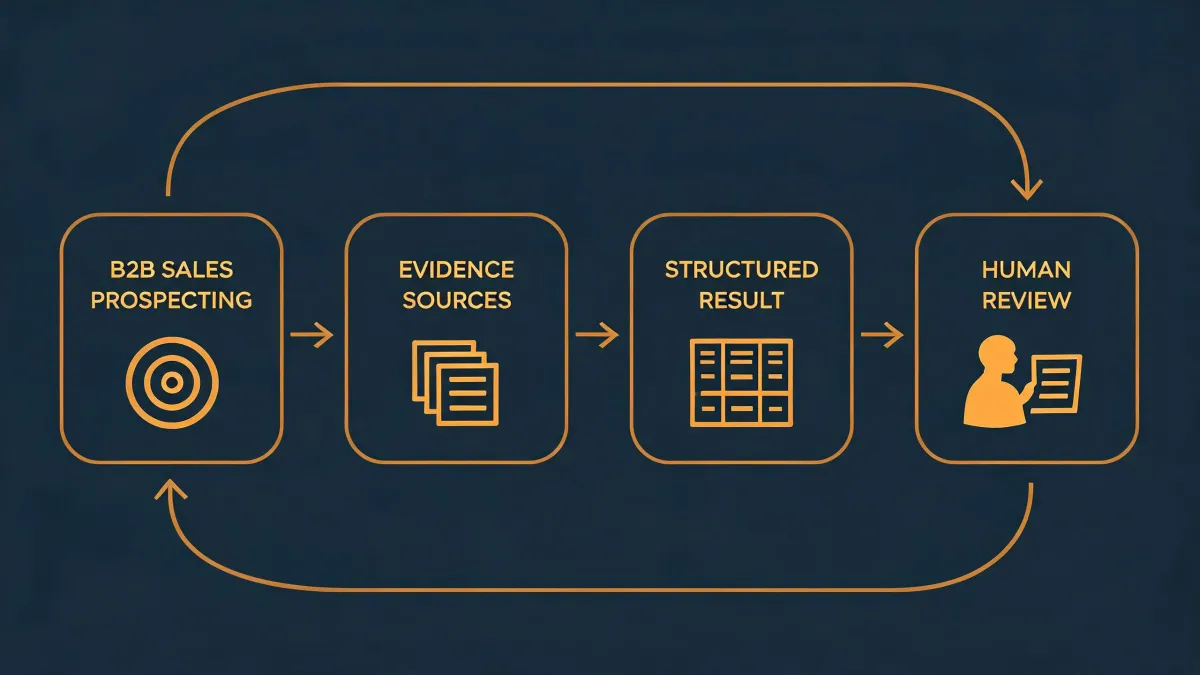
The Short Answer
If your email verification tool runs on its own, it's costing you more than you think. The real expense isn't the subscription—it's the 6 to 8 minutes per contact you lose to manual handoffs, and the sending credits you blow on addresses that were never going to work. When verification is embedded inside the prospecting workflow, the math changes. Not because it gets cheaper on the invoice. Because you stop paying for the same bad data twice.
I've spent four years tracking this stuff. The difference never shows up on a pricing sheet. It shows up in the workflow.
Why I Started Paying Attention
I manage our sales stack budget—roughly $120,000 to $140,000 annually across outreach, prospecting, and data enrichment. Four years of negotiating with vendors, and the lesson I keep relearning is that a clean quote can hide 25-40% more in total cost of ownership.
In 2023, we sat down and compared two prospecting platforms against four email verification services over a full quarter. I almost went with the cheapest verification option—until I mapped the complete workflow per contact. The manual steps alone accounted for over 30% of the real cost.
We didn't have a formal SaaS renewal review process back then. Cost us when a verification tool auto-renewed in February and we didn't catch it until June. I built a checklist after that. Should have done it sooner.
Where the Money Actually Leaks
Start with a standalone verification tool. Here's the workflow:
- Export contacts from the prospecting platform
- Upload to the verification tool
- Wait for verification to complete
- Download the cleaned list
- Re-import into the sending tool
Five steps. Three of them manual. Each one eats budget.
Leak #1: Double billing. The verification tool charges per email checked. The sending tool charges per email sent. If verification happens too late, you've already paid to send to bad addresses. I tracked this on our team—about 18% of verification credits went to addresses that had already burned sending credits. Double waste.
Leak #2: Manual processing. Account for the time someone on my team spends on this, converted to their hourly cost. About 6-8 minutes per export-import cycle. Sounds small. But across 2,000+ contacts per quarter, that's 200+ hours. At our RevOps rate, that's real dollars that never show up on any vendor invoice.
Leak #3, and the biggest: domain reputation repair. When unverified emails go out, bounce rates climb. When bounce rates cross 2-3%, deliverability drops. Fixing that means domain rotation, warm-up sequences, and throttled send volume. Cost us roughly 40 hours of engineering time last year. That's more expensive than any verification subscription.
What an Agent-Native Workflow Changes
We moved to okkigo's platform. Not because it had the most features—because verification sat inside the lead generation process instead of after it.
okki go lets you prospect with natural language. I'd type something like "find 200 VPs of Marketing at Series B SaaS companies in North America who posted on LinkedIn in the last 90 days." That query—the natural language prospecting part—returns records with verification status already attached.
The difference is subtle. The cost impact isn't.
For LinkedIn prospecting, this matters even more. When you pull from LinkedIn, emails aren't native. You scrape or you use a third-party. Most verification tools treat LinkedIn-sourced emails as a separate batch. In an embedded workflow, verification is part of the process—emails get found, verified, and delivered without a separate reconciliation step. (Should mention: this depends on whether you've got the verification add-on enabled. Confirm before you buy.)
CRM enrichment is where it gets interesting. When verification status becomes a field on the contact record in your CRM, reps know which leads are fresh and which need a re-run. That turns data hygiene from a quarterly cleanup into a continuous process.
Why does this matter? Because every manual step you remove is a step somebody doesn't get paid to redo.
When This Doesn't Apply
A few important caveats.
If you're already locked into an annual contract with a verification tool, the fixed cost is sunk. Embedding verification won't save you money until renewal. Unless they're charging overages or adding seat fees, there's no reason to switch mid-term.
If your team is large enough to have a dedicated RevOps function, standalone verification can work fine. They'll automate the workflow to the point where the manual steps mostly disappear. My calculation depends on having a small team where every manual step has a real hourly cost.
If your sending volume is under 500 addresses per month, the math might not work. Adopting a platform for embedded verification only makes sense if the rest of the feature set earns its keep. At low volume, many verification tools offer much cheaper per-address rates. Small teams honestly get squeezed here—same manual steps, same wasted credits, smaller numbers to absorb them. I've seen 300-send operations burn subscriptions on tools they didn't need because their data was never synced. That pattern is avoidable.
I can only speak to mid-size B2B companies—250 to 1,000 employees, dedicated SDR teams, no full RevOps department. Your mileage may vary if you're a different shape.
Oh, and one more thing: I'm not an AI specialist. I can't tell you how the underlying models work or whether one LLM is better than another. What I can tell you from a procurement perspective is how to measure whether an agent-native workflow actually removes cost—or just shifts it to a line item you haven't checked yet.
Vendors who take small orders seriously tend to take workflow details seriously too. That pattern has held up for me more often than not.