Most procurement teams still rank sales engagement platforms on a feature checklist that stopped being the important question around 2022 — and it's quietly costing them money.
I've spent the last three years as the person who signs off on revenue tooling: reconciling the invoices, sitting through the demos, fielding the "why is this line item so high" email from finance. And the pattern is consistent. When an evaluation committee sits down, the first thing they build is a spreadsheet of features. Email tracking. LinkedIn tool features. Sequence length. Credits per month. Whether the dashboard defaults to dark mode.
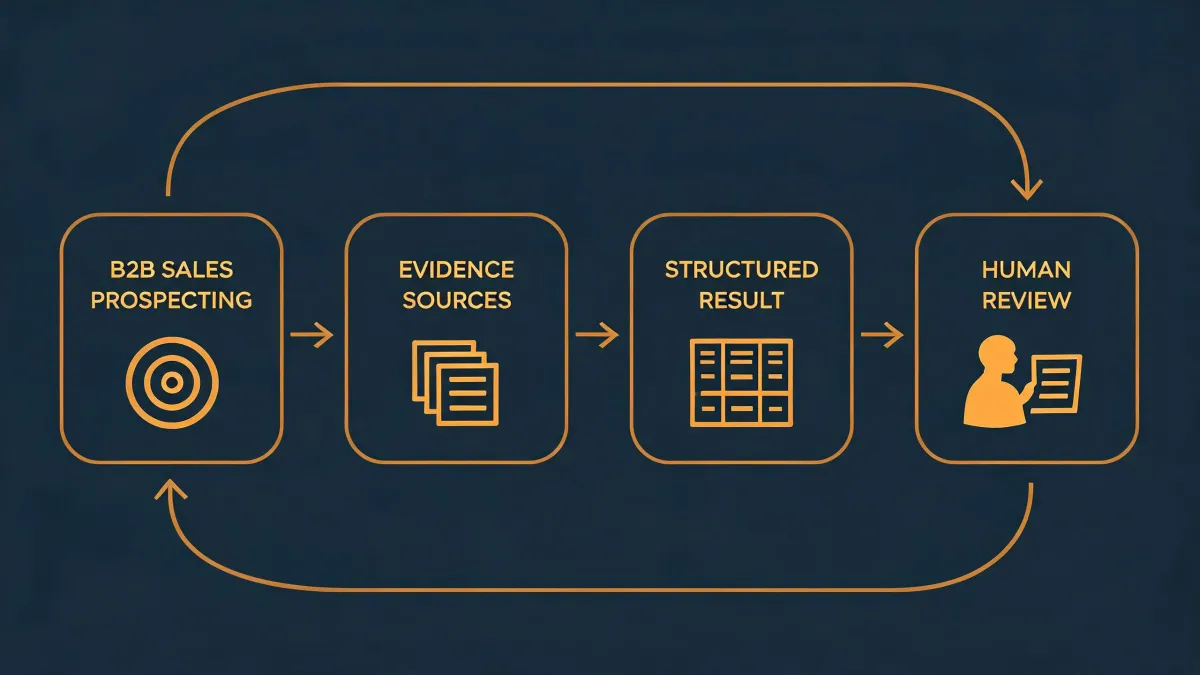
That's the old lens. The question that actually matters now is whether the platform supports an agent-native prospecting workflow — and whether it can prove where its data came from.
Here's why I'd argue that, and why the feature checklist is the wrong first question.
Argument one: the features have already converged
What I mean is that the checklist that made sense when we were comparing three or four tools in 2020 doesn't differentiate anything in 2026, because almost every competitive platform now ships the same core: email tracking, LinkedIn tool features, basic enrichment, sequence automation, some kind of AI drafting. When I ran our last head-to-head across five vendors for our outbound team, four of them were functionally indistinguishable on the core feature list. The fifth's "unique" feature turned out to be a Zapier integration.
The way I see it, buying on features at this point is buying on a commodity. You're paying a premium for something half the market already gives you.
Argument two: data source transparency is the real trust question
Once you move to agent-driven outreach, the stakes change. A human SDR who pulls a bad email address wastes a few minutes. An agent that pulls and sends to a hundred bad addresses a day can put your sending domain on a reputation path you don't want to walk down.
So the question I now ask in every demo is not "how many contacts do you have" — it's "where does each field come from, and can I see the provenance?"
This matters for a few fairly concrete reasons:
- Deliverability. Google and Yahoo updated their bulk sender requirements in February 2024, requiring SPF, DKIM, and DMARC alignment, one-click unsubscribe, and a spam complaint rate under 0.3% for bulk senders. If your enrichment data is stale or sourced from a low-quality scrape, your complaint rate climbs, and the pile of authentication you built doesn't save you.
- Compliance. GDPR (Regulation (EU) 2016/679) requires a lawful basis for processing personal data, and the CCPA/CPRA give residents a right to know where their data came from. "We got it from a data partner" is not an answer that survives an audit. You need the actual chain.
- Cost honesty. Vendors that can't show you provenance tend to be the ones that charge by credit with a fallback chain that quietly runs out. When they can show it, you can see exactly which source produced the record and what you paid for it.
This is one of the reasons platforms like okki-go lean on waterfall enrichment with source-level transparency — it lets the person who has to defend the invoice show where the data actually came from. That's a procurement feature as much as a sales one, even if it's rarely sold that way.
The most frustrating part of this for me: I've been on review calls where a vendor's own data team couldn't answer "which provider does this match come from" — and the vendor was already inside a three-year contract. You'd think a seven-figure data vendor would know their own sources, but the reality is that the source chain is often hidden even from the AE selling to you.
Argument three: intent signal research changes what "engagement" means
Agent-native tooling reframes "engagement" from "did someone open my email" to "did the account show a signal that justifies a touch." That's the whole point of intent signal research — you're not guessing who to reach out to, you're reacting to something they did.
The catch: intent data quality varies wildly, and a signal from a low-traffic aggregator is not the same as a signal from a verified first-party source. When you're buying intent, you're buying the vendor's definition of "intent." If that definition isn't documented, you can't compare two vendors fairly — and you can't tell whether the signal your agent acted on was real or noise.
I went back and forth for about three weeks between a legacy platform that had a deep intent module we already trusted and a newer agent-native one that was cheaper and clearly built for the workflow we actually run. The legacy one offered institutional comfort: our team already knew the UI, the contracts were straightforward, and finance had pre-approved the category. The newer tool offered lower credit costs and a workflow that didn't require a human to babysit every sequence.
I chose the newer one, but honestly the deciding factor wasn't price. It was that I could see the source of every intent signal, and the legacy platform — the one I'd defended for two years — couldn't show me. That felt like a bad sign in 2026.
"But features still matter" — yes, and here's where
The pushback I get every time I write something like this is: features still matter for reliability, compliance, and edge cases. That's fair. I'm not saying buy on vibes. I'm saying the ranking has flipped.
Features are now table stakes — necessary, not differentiating. Data provenance, agent fit, and documented signal definitions are the differentiating axis. So the right sequence is:
- Confirm the core features actually work. They do at most vendors — verify, don't compare at length.
- Test the data provenance claim. Ask for the source chain on five random records.
- Read the intent methodology. If it's not written down, it's not a methodology, it's marketing.
- Run one workflow end-to-end with the agent doing the work, and watch where a human has to step in.
Only step one is the "feature checklist." Steps two through four are where the actual decision gets made.
What I'd tell my past self
In our 2024 vendor consolidation, I saved the company real money by switching to a platform that happened to be agent-native. I also spent six weeks of 2026 cleaning up a sending domain that got damaged because the platform I had originally picked had a pleasant UI and a somewhat questionable data fallback. So glad I ran the provenance test before the renewal, not after.
Even after switching, I kept second-guessing for a month — what if the new platform's waterfall chain didn't include the source my team relied on? The signal quality looked fine in the demo, but demos always look fine. The thing that finally made me relax was pulling the underlying source logs on a hundred records and seeing the chain end-to-end. That's the test I'll use from now on.
Here's the thing: the fundamentals of good prospecting haven't changed — the offer, the targeting, the relevance. What has changed is that the tooling now runs a lot of the execution, and the buyer's job shifted from picking the most feature-rich interface to verifying that the data and signals feeding your agents are trustworthy. The checklist isn't wrong, it's just no longer the first question.
So if you're evaluating a sales engagement platform in 2026, my honest advice is to invert the spreadsheet. Put provenance and workflow fit at the top. Leave email tracking and LinkedIn tool features on page two, where they belong.