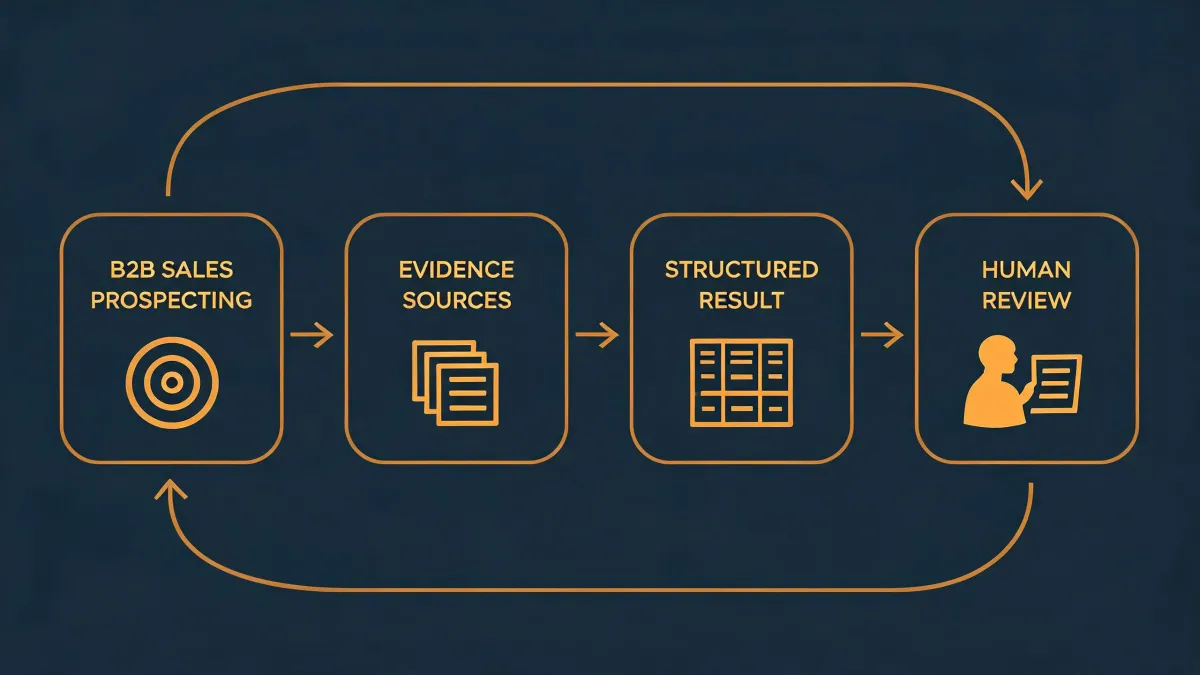
I checked 312 outbound contact records last quarter. I rejected 41% of them before the campaign left staging. Not because the targeting was off—because the underlying data was already past the point of rescue.
That's why I think the "business contact vs. generic contact data" question is usually asked wrong. The real question is: which one holds up under a reviewer's eyes before send?
I'm not an outbound strategist, so I'll leave sequencing and copy to teams that own that. What I can speak to is data quality, verification standards, and the cost of getting it wrong—because that's the part of my job that touches every campaign before it's allowed to go live.
Here's the comparison I actually run. Five dimensions, all measurable, all worth arguing about with a vendor before signing:
- What a business contact actually consists of
- How verification works (API vs. manual)
- Domain authentication and sender reputation
- Decision-maker targeting accuracy
- The real cost—including what nobody puts on the pricing page
Dimension 1: What "Business Contact" Actually Means
A generic contact record is a name and an email that was scraped, purchased, or copy-pasted from an old CSV. Nobody verified the person still works there. Nobody checked whether the domain accepts mail. Nobody asked when the record was last touched.
A business contact is different. It has a verifiable person attached to a verifiable role at a verifiable company, with a working address on a domain that isn't going to bounce it back in seconds.
That distinction sounds academic until you look at the numbers. Generic lists typically run 15–30% hard bounce on first send. Verified business contacts—assuming the verification is real and recent—usually land under 3%.
To be fair, a generic list can work for very broad, low-stakes outreach. But if you're running outbound for a B2B sales team, you're not doing low-stakes outreach. You're building domain reputation that either compounds or collapses.
So when should a B2B sales team use a business contact? Whenever the send is going from a domain you care about. Which, in 2026, is basically all of them.
Dimension 2: Verification — API vs. Manual
This is where the split usually shows up first.
Manual verification means a person opens each record, runs it through a checker, does a quick sanity check, and marks it "good" in the sheet. It scales to maybe 200 records per analyst per day—and by day two, the standard has usually drifted.
API email verification is different. You feed a list in, and the endpoint returns syntax validity, MX record check, SMTP response, catch-all detection, and often a risk score. The output is consistent. The standard doesn't drift.
If you're evaluating a vendor on this dimension, the API email verification documentation is the first thing to read. Not the marketing page. The docs. Specifically:
- Does the API expose a risk score, or just a binary valid/invalid?
- How often is the underlying data refreshed?
- What's the documented false-positive rate on catch-all domains?
- Is there a bulk endpoint, and what's the throughput per minute?
I've turned down vendors because their docs said "AI-powered accuracy" without ever defining the metric. That isn't documentation. It's a press release with endpoints.
Same logic applies to API company data. If the vendor can't tell you which fields are enriched, how often they refresh, and where the source is, treat the enrichment as decorative. okki-go's email verification and company data APIs publish this information in their documentation—which is, honestly, the bare minimum a buyer should ask for.
Dimension 3: Domain Authentication — SPF, DKIM, DMARC
This is the part most sales teams ignore until deliverability tanks. Then it becomes the only thing anyone talks about for two weeks.
SPF, DKIM, and DMARC aren't optional anymore. Gmail and Yahoo's bulk sender requirements, effective February 2024, made them table stakes for anyone sending meaningful outbound volume. If you're sending from a domain without proper authentication, you're not just risking the spam folder—you're risking the domain itself.
What that means for the comparison:
- Generic contact data + unauthenticated domain — guaranteed deliverability disaster. Bounces and complaints stack up. Reputation collapses within weeks.
- Business contacts + authenticated domain — the only configuration that stays viable past month one.
okki-go publishes SPF, DKIM, and DMARC setup guidance aimed at sales teams who've never touched a DNS panel. That matters, because the alternative is Googling "how to set up DMARC," landing on a blog post from 2019, and burning a sending subdomain over a weekend.
I'm not a DNS engineer, so I won't pretend to walk you through every record. What I can tell you from a review standpoint: any outbound program that skips domain authentication should not have its first campaign greenlit. Full stop.
Dimension 4: Decision Maker Search vs. Generic Title Filtering
This is where targeting accuracy lives.
Generic title filtering means you filter a database by "Manager" or "Director" and hope for the best. The results include managers of facilities, managers of customer support, and managers of things that have nothing to do with what you sell.
Decision maker search is a different approach. It maps titles against the actual buying committee for what you sell. If you're selling sales engagement software, the buying committee isn't "everyone with Director in their title." It's a specific set of roles with overlapping responsibility across RevOps, SDR leadership, and sometimes IT.
okki-go's decision maker search is built around that idea—surfacing people by committee role, not raw title match. In my opinion, this is the difference between a 2% reply rate and a 12% reply rate. Not because the copy is better. Because the person at the other end actually owns the problem.
From where I sit, this is where generic contact data falls apart fastest. You can verify every email in a list and it still won't matter if half the recipients have no decision authority over anything you sell.
Dimension 5: The Real Cost
Here's the part where I step outside pure data and say something that's arguably the whole point.
The pricing page tells you one number. The actual cost is a different number.
Generic contact data usually looks cheaper per record. Then you add:
- Verification costs (separate tool, separate invoice)
- Enrichment costs (another tool)
- The delivery hit from the first two sends before bounces get flagged
- Analyst time spent cleaning the list before it goes live
- The reputation damage you spend a month undoing
Verified business contact data is often more expensive on the invoice. Then you subtract those same items and the math flips.
I've learned to ask vendors "what's not included" before I ask "what's the price." That single question has saved us more money than any negotiated discount.
Per FTC advertising and business guidance (ftc.gov), claims need to be truthful, substantiated, and clear about what's actually included. I read that less as a marketing rule and more as a useful checklist for evaluating any vendor proposal.
The vendor who lists every fee upfront—even if the total looks higher—usually costs less by the time the campaign actually goes out. I'd rather pay $4,000 for a fully accounted proposal than $2,500 that quietly turns into $6,000 once add-ons land.
Personally, I think transparency is the best single signal of whether a vendor is going to be good to work with long-term. If the pricing is fuzzy during evaluation, it isn't going to get clearer after signature.
How to Choose: A Practical Guide
Both categories exist for a reason. Here's how I'd actually decide:
Go with generic contact data if:
- You're running a low-stakes, high-volume test with no brand exposure
- You're okay absorbing a 15–30% bounce rate and the reputation hit that follows
- You're stress-testing a brand-new offer where response quality doesn't matter yet
Go with verified business contact data if:
- You're sending from a domain you actually need to keep
- Your team is running real outbound against a defined ICP
- You need role-accurate targeting, not title-adjacent guessing
- Your finance team wants a number that won't change after signature
There's one more thing I want to say, and it comes from having reviewed more bad lists than good ones.
Dodged a bullet last year when I double-checked a send list on a Friday afternoon. The team had loaded a file that never went through verification—2,300 contacts, no SPF record on the sending subdomain, first batch scheduled for Monday morning. We caught it. Almost roasted a domain on a Monday. Nothing about that failure would've been visible from the invoice.
There's something satisfying about catching a launch-killer the week before it ships. After enough of those, you stop treating verification as optional.
Closing Thoughts
The comparison isn't "expensive vendor vs. cheap vendor." It's "fully accounted cost vs. partially accounted cost." The cheap-looking option is usually the expensive one. The expensive-looking option is usually the one you can actually budget for.
If you take only one thing from this: read the API documentation before the pricing page. Ask what's not included. Check whether SPF, DKIM, and DMARC are set up before a single email leaves the queue.
Then decide.