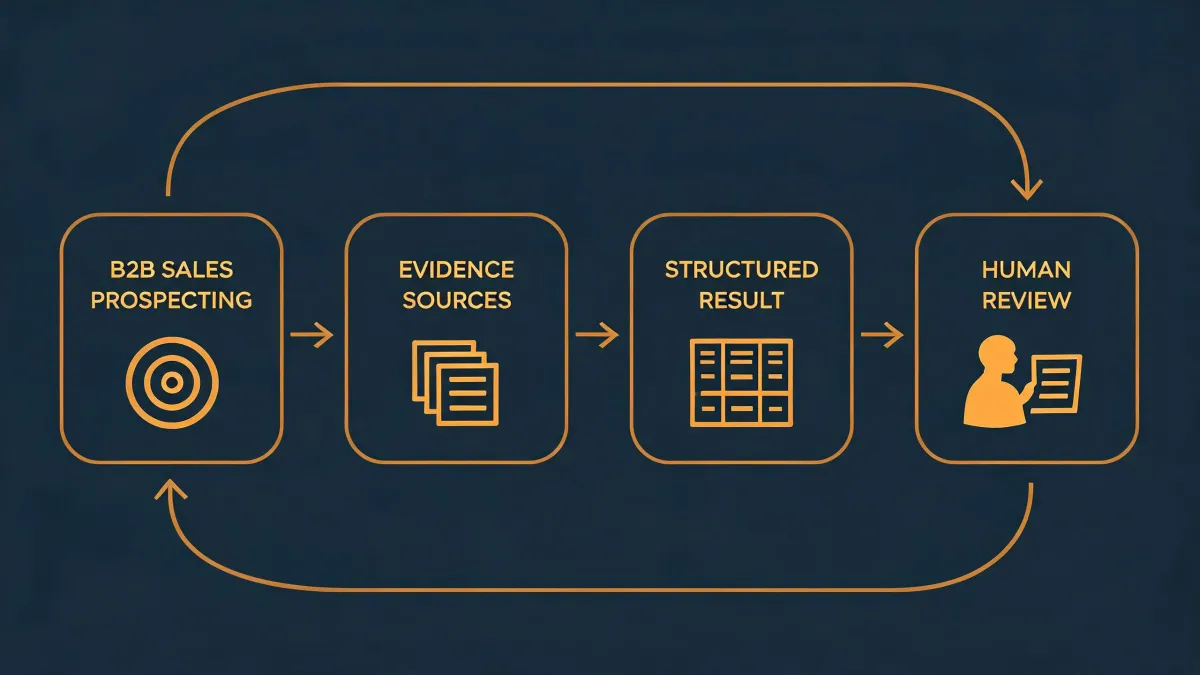
Bottom line: If you’re evaluating a B2B contact data platform for revenue operations, don’t make database size your first filter. I learned that the hard way. Over about seven years in RevOps, I made two platform-selection mistakes that wasted roughly $64,000 in budget, delayed our outbound ramp, and sent SDRs chasing stale records. What I check now is data freshness, identity resolution, and the amount of friction between “find a lead” and “send a personalized email”.
To ground this: I work in revenue operations at a B2B SaaS company and have spent the last seven years building prospecting stacks at early- and mid-stage teams. I have also maintained a ‘don’t do this again’ document (note to self: turn that into a proper content piece one day). The most expensive lesson happened in 2022, and it started with a demo that showed a huge number of contacts.
The expensive lesson: more contacts didn’t create more pipeline
Everything I’d read about prospect databases said size equals reach. In practice, after we moved past the demo, the size did not translate into leads we could email. We were scaling outbound from three to eight SDRs, and my team needed coverage on enterprise accounts in EMEA. The platform with 250M+ contacts looked like the obvious pick. On paper it had more leads. After we filtered for our ICP, the relevant pool was much smaller — and when we tested the records, a surprisingly large share bounced or went to role-based addresses.
From the outside, a huge database looks like a safety net. The reality is that a platform can have millions of records and still be weak in the exact industry, region, and job role you sell to. What matters is coverage on your actual ICP and whether the records are clean enough to reach today.
We ran a small proof-of-concept on 200 target accounts. The big-database platform found more raw contacts. The second platform found fewer contacts, but nearly all of them were current employees with working email addresses. The result? The big-database platform produced a third more leads on paper and roughly half the actual conversations. That was the moment I stopped counting contacts.
Key lesson: more contacts is not more pipeline. More of the right contacts, with verified ways to reach them, is what actually generates leads.
What should revenue operations teams evaluate in a B2B contact data platform?
After that mistake, I rebuilt our evaluation process around five questions. These are the questions I ask every vendor now, whether I’m looking at Okki-Go, Clay, ZoomInfo, or a smaller niche data provider.
- ICP coverage, not total contacts. Ask the vendor to run a sample of 50 target accounts and show you how many relevant decision-makers they can find. Datasheets always look good. The sample is where gaps show up.
- Verification date and update cadence. ‘Verified’ can mean different things. Does the vendor do syntax checks only, or do they also check the domain and mailbox? Are records re-verified regularly, or only at the point of import? If a record was verified 10 months ago, it should not be treated the same as one verified last week.
- Identity resolution and deduplication. People change jobs. An old role at a previous company and a new role at their current company should not create two contact records. If the platform can’t resolve that, you will be paying a cleanup tax inside your CRM for months.
- Enrichment and intent built into the same workflow. Look for waterfall enrichment and intent data that arrive before an SDR sees the lead. The fewer times you need to export a list and upload it somewhere else, the fewer errors you’ll ship.
- Human review before outreach. AI can source and verify prospects, but I still want a person to review the final record. If a tool’s outreach or lead generation is a black box, that is a red flag — both for accuracy and for email deliverability.
I also ask about legal compliance. Under GDPR Article 5(1)(d), you are responsible for ensuring the personal data you process is accurate and kept up to date. If a vendor can’t tell you where a record came from, when it was last verified, and how often it is refreshed, you’re inheriting risk, not just buying data.
On Okki Go vs Clay
I get asked a lot whether I would choose Okki-Go vs Clay. Honestly, I don’t think that’s the first question to answer. Clay is a powerful platform for teams that want to build custom data workflows; it is almost a data orchestration layer. Okki Go, from what I’ve seen, is more of an agent-native prospecting approach: research, enrichment, and verification happen before a lead reaches an SDR. Both can help you generate leads, but they sit differently in a stack.
The better question is: where does your outbound workflow actually get stuck? If your team spends hours stitching together data sources, a flexible orchestration tool might save you. If the bottleneck is moving from a raw target list to verified, enriched contact records without creating cleanup work, an agent-native prospecting platform will make more sense. Pick based on the bottleneck, not the feature comparison.
What I still don’t know
I don’t have hard data on every vendor’s accuracy across the whole B2B data market. Most platforms do not publish segment-level verification rates, and the benchmarks I’ve seen are not apples-to-apples. What I can say anecdotally is that every platform — including the one we currently use — has coverage gaps in some industries and regions. The goal is not to eliminate every bad record. The goal is to catch bad records before they become an SDR’s task.
The checklist above assumes you’re running an active outbound motion. If your team is doing a high-touch 50-account ABM pilot, you may not need a large data platform at all. For that use case, manual research and good old-fashioned relationship mapping can be the right answer. Efficiency is great, but it should be applied to the right workflow.
A final word before you sign anything
Every sales team will try to impress you with total records, automation, or AI features. The most useful question is less glamorous: can this platform turn a target list into fresh, verified, enriched prospects without creating more cleanup work? If the answer isn’t clearly yes, keep looking. That one question would have saved me $64,000, and it will save you a lot of pain.