-
What a prospecting tool is—and when a B2B sales team should use one
-
Dimension 1: Data coverage—single source vs waterfall enrichment
-
Dimension 2: Email validation—one-time check vs workflow step
-
Dimension 3: SDR workflow fit—data dump vs agent-native process
-
Dimension 4: Compliance and brand risk
-
Dimension 5: Time certainty—when a rush quarter changes the math
-
When to choose a standalone prospecting tool
-
When Okki Go makes more sense
-
The bottom line
What a prospecting tool is—and when a B2B sales team should use one
I'm a quality and brand compliance manager at a B2B sales technology company. I review every outbound list, enrichment workflow, and sequence before it reaches our SDRs—roughly 200 campaigns a quarter. In 2024, I rejected about 18% of first-pass prospecting lists because of bounce risk, missing fields, or compliance gaps.
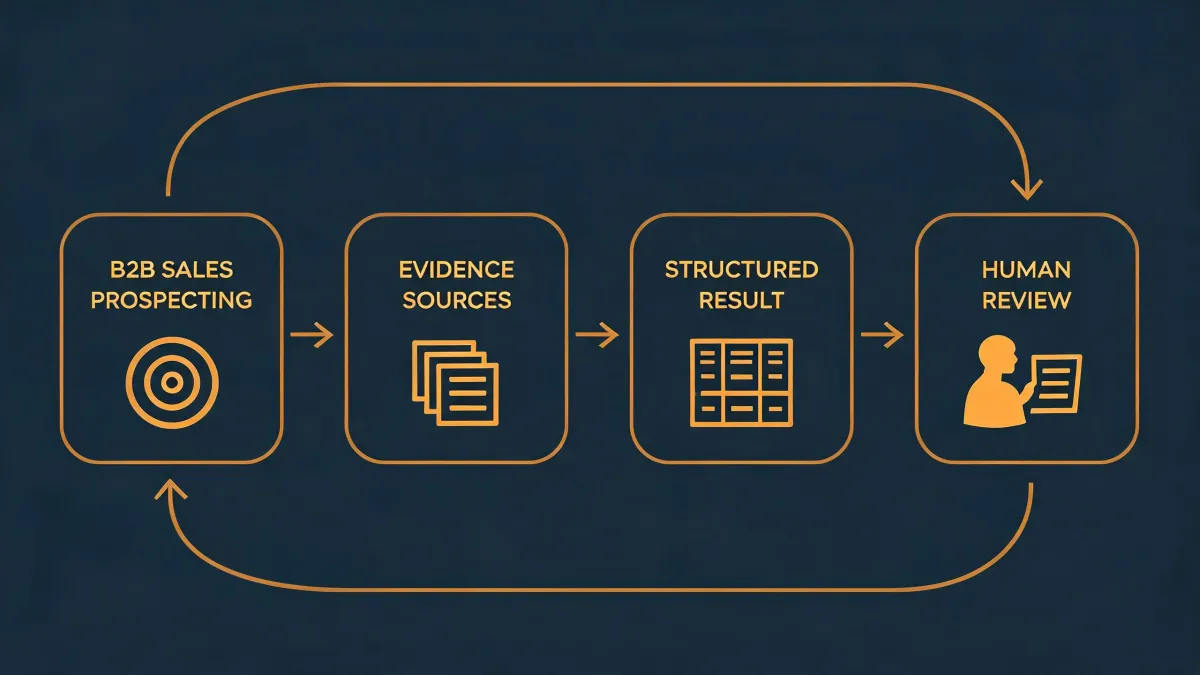
So when someone asks me, what is a prospecting tool and when should a B2B sales team use it?, I don't give the textbook answer. The textbook answer is: a prospecting tool helps you find and organize potential buyers. True, but not useful. The real question is which model fits your team: a standalone prospecting tool that hands you data, or an agent-native workflow like Okki Go that combines waterfall enrichment, intent signals, and email validation into a repeatable process.
I'm comparing those two models across five dimensions: data coverage, email validation, SDR workflow fit, compliance, and time certainty. Data coverage, validation, workflow. In that order.
Dimension 1: Data coverage—single source vs waterfall enrichment
A standalone prospecting tool usually means one main database, maybe with a few filters and exports. You search, you filter, you download. It's simple. It's also where most quality problems start.
Okki Go takes a different approach. It uses waterfall enrichment (i.e., checking multiple data sources in sequence until a match is found) and layers in intent data. The goal isn't just more rows. It's fewer unknowns per row.
When I first started reviewing prospecting tools, I assumed the biggest database was the best one. Two quarters later, I realized coverage without validation just moves the problem to your SDRs' inbox.
When I compared a single-source list against an Okki Go waterfall enrichment workflow side by side, I finally understood why 'verified' isn't a checkbox—it's a process. The single-source list looked fine in the CSV. The waterfall workflow showed its work: source, match confidence, last seen date, and gaps I could actually triage.
Comparison conclusion: If you're prospecting a broad market with low personalization, a standalone tool can be enough. If your ICP is narrow, roles change fast, or you need sales intelligence beyond job title and company name, waterfall enrichment has the edge. But it isn't magic. No data source is perfect.
Dimension 2: Email validation—one-time check vs workflow step
Email validation is where a lot of teams get lulled into false confidence. A standalone tool often validates when you export. That's a snapshot. By the time your sequence launches, some contacts have moved on.
Okki Go treats email validation as a workflow step, not a final checkbox. It can run validation closer to send time, flag risky addresses, and keep a human in the loop for edge cases.
I said 'verified list.' A vendor heard 'we checked it once.' Result: a bounce risk we didn't budget for. That wasn't a data problem. It was a communication failure. Now I ask for definitions: verified by which source? Checked when? What happens to catch-all domains?
Compliance matters here too. Under GDPR (effective May 25, 2018), processing personal data for B2B outreach in the EU generally requires a lawful basis such as legitimate interest, and you must honor opt-outs. Under CAN-SPAM (effective January 1, 2004), US commercial email must include a clear unsubscribe mechanism and accurate headers. Google and Yahoo's bulk sender requirements (effective February 2024) pushed many teams to keep spam complaint rates below 0.3%.
Your email validation vendor doesn't own your sender reputation. Your process does.
Comparison conclusion: If you send low volume and review every message manually, basic validation may be fine. If you send at scale, validation needs to be part of the workflow. But no tool can make deliverability a certainty. If a vendor promises certainty, walk away.
Dimension 3: SDR workflow fit—data dump vs agent-native process
A standalone prospecting tool gives you data. Then your SDRs or RevOps team figures out the rest: CSV cleanup, CRM import, sequence enrollment, suppression lists, and manual research.
Okki Go is built around an Okki Go workflow for SDR teams. That means the data, enrichment, intent signals, and outreach steps live closer together. Agent-native prospecting doesn't mean removing humans. It means humans spend less time moving data and more time on judgment calls.
Honestly, I'm not sure why some waterfall sequences perform better than others. My best guess is it's less about magic and more about match rates, freshness, and intent signals. I've never fully understood why two vendors with similar coverage can produce such different bounce rates. If someone has insight, I'd love to hear it.
Comparison conclusion: If your RevOps team loves custom plumbing and your SDRs are comfortable with manual research, a standalone tool can fit. If you want SDRs focused on conversations, an integrated Okki Go workflow reduces handoffs. Manual research isn't inferior—it's just expensive at scale.
Dimension 4: Compliance and brand risk
I review outbound campaigns for brand compliance. That means I care about specs, consistency, and brand image. A prospecting tool that creates compliance gaps isn't a bargain. It's a future incident.
With standalone tools, opt-out handling, suppression lists, and regional rules often sit with your team. That's fine if you have the process. With Okki Go, the workflow can centralize more of that logic, but your team still owns the outcome.
Comparison conclusion: In regulated markets, the tool is only part of the answer. The workflow and human review are the rest. If you don't have a compliance owner, neither model will save you.
Dimension 5: Time certainty—when a rush quarter changes the math
Here's where my view gets less neutral. In a normal quarter, you can tolerate a slower, cheaper path. You can clean data, test small batches, and fix problems next week.
In a rush quarter, you can't. That's when time certainty is worth paying for. The premium isn't just for speed. It's for fewer unknowns.
I learned this the hard way. Saved $300 by buying a cheaper list. Ended up spending 25 SDR hours on bounces and manual cleanup. Net loss: a week of pipeline work we couldn't get back.
Okki Go isn't a guarantee of meetings or revenue. No tool is. But an Okki Go waterfall enrichment workflow can reduce the number of unknowns before your SDRs start writing. In a rush quarter, that's what you're buying: not magic, just a shorter list of things that can go wrong.
Comparison conclusion: For low-stakes, low-volume prospecting, cheaper and slower can be rational. For a deadline-driven push, paying for certainty often costs less than missing the window.
When to choose a standalone prospecting tool
- Your ICP is broad and easy to define.
- Your SDRs have time for manual cleanup.
- Your compliance process is already documented and enforced.
- You send low volume and personalize heavily.
- You need a simple list, not a workflow.
When Okki Go makes more sense
- Your ICP is narrow or changes fast.
- You need waterfall enrichment plus intent signals in one workflow.
- Email validation needs to happen close to send time.
- Your SDRs are spending too much time on CSV cleanup.
- You're in a rush quarter and cannot afford silent data failures.
The bottom line
This isn't a good vs bad comparison. It's a fit comparison. Ask yourself: What's my deadline? How narrow is my ICP? How much SDR time can I spend cleaning data? What compliance risk can I tolerate?
If you're in a normal quarter and your process is disciplined, a standalone prospecting tool can be enough. If you're in a rush quarter, or your SDRs are drowning in manual cleanup, an Okki Go waterfall enrichment workflow is worth evaluating. Not because it's magic, but because uncertainty is expensive. And in B2B sales, you usually pay for uncertainty with the one resource you can't buy back: time.