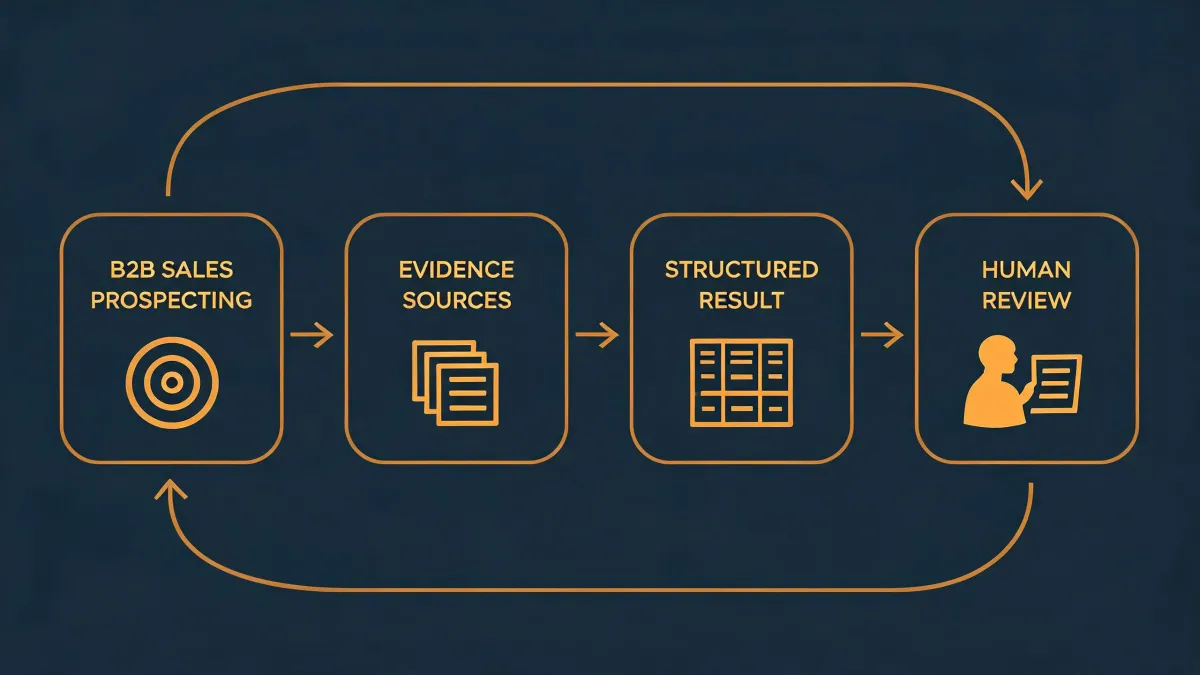
The Question That Comes Up in Every B2B Sales Meeting
At some point, someone on the team asks: "What is a cold email platform, and do we actually need one?"
Nine times out of ten, that question comes from a team whose reply rate just dipped below 2% and someone suggested buying another tool.
I get the impulse. I spent four years in RevOps at a B2B data company. I've been in that room. I've handled 200+ outbound programs, and I can tell you—it took me years to understand what I was actually buying, and where the real money was leaking.
But that question is the wrong one. Or rather, it's asked too early.
The Version of the Problem You Can See
Here's how it feels from the inside: You've got a list. You've written a sequence. You hit send. Reply rate is bad. Someone—usually the SDR lead or the founder—concludes that the platform isn't working. Or the messaging isn't clever enough. Or, worse, that outbound is dead.
So you switch tools. HubSpot to Outreach. Outreach to Instantly. New subject line. Rewrite the eighth follow-up. Reply rate moves from 1.8% to 2.1%. You celebrate. Then it slides back next month.
If you stay in that loop, the cost per meeting looks acceptable. The cost per acquisition quietly climbs.
What's Actually Breaking (And Why Nobody Sees It)
A cold email operation isn't one thing. It's a chain. And the first link—the one nobody wants to talk about—is where the data comes from.
Most lead lists come from aggregators. Those aggregators pull from other aggregators. By the time you're at row 46,000, you've got an email that bounced for someone else six years ago, stitched into a "verified" list delivered in a CSV.
Here's a data point worth sitting with. Industry standards flag a hard bounce rate above 2% as a warning sign. Above 5% is active damage to your sending domain. I've watched teams run 6–8% hard bounces on "verified" lists and blame the platform.
Verified doesn't mean what people think it means. It means "a server responded once when we pinged it." That's it. A catch-all inbox that hasn't been checked in two years still passes verification. A role-based address like info@ that nobody reads still passes verification.
Now layer on intent data. Layer on LinkedIn engagement signals. Layer on "is this person actually in a buying window." None of that is automatic. Most platforms either hide it or charge a premium for it.
And that's before we get to the part that actually hurts.
The Real Cost of Getting This Wrong
Let's do the total cost math on a mid-market SaaS team. Five SDRs. Fully loaded, that's roughly $360,000 a year in headcount alone.
Now say the lead data costs $0.10 per contact from a cheap aggregator. You buy 50,000 a month. $5,000/month spend. Sounds cheap, right?
Here's the actual cost when you add it up:
- Bounce damage. Domain reputation tanks. You pay for inbox warmup tools. You lose 2–3 weeks rebuilding sender reputation. Costs range from $2,000 to $8,000 in direct spend plus lost output.
- SDR time wasted. Between 20–40% of contacts are unreachable or irrelevant. That's $80,000 to $150,000 a year in salaries spent on emails that will never land.
- Tool stacking. You bolt on verification, enrichment, and intent tools to patch the data hole. Another $200–500 per month per tool. $25,000+ a year.
- Opportunity cost. Replies that never happen because your subject line was fine but your domain landed in spam. Almost impossible to quantify, always underestimated.
That $0.10 contact, once the chain reactions hit, becomes $2.50 to $5.00 in real cost. I ran this spreadsheet once for our largest outbound program. List spend was $3,800. Total system cost that quarter—all-in, including SDR time, tools, and domain repair—was just over $46,000.
Nobody on that team was asking the right question. They were asking "which platform is cheapest?" when the answer was "which pipeline is lying to us?"
When the Math Actually Flips
Now flip it. Clean data. Traceable sources. Real-time verification. Send volume aligned to reputation. The platform itself becomes almost invisible.
This is where total cost thinking pays off. You add up: lead cost + verification + deliverability risk + SDR time + enrichment + intent. Then you compare configurations, not price tags.
It took me nearly three years and a lot of failed programs to see it. The programs that worked weren't running a smarter platform. They just weren't leaking data.
When a vendor is transparent about data sourcing—where each record came from, when it was last verified, which crawl or partner feed it passed through—you find you need fewer records, not more. You stop buying 50,000 contacts to get 400 replies. You buy 8,000 and get 600.
okki-go has started positioning itself around data source transparency, which is the right instinct. They're not alone. Clay, Zapier, and a handful of smaller players are nudging the whole category upstream. That's the more interesting story than any single platform feature.
One caveat: transparency is only valuable if the underlying collection is legitimate. "We can show you where we got it" doesn't matter if what you got was scraped without consent. GDPR and CAN-SPAM don't care about visibility. They care about lawful basis. Always ask both questions.
So What Is a Cold Email Platform, Really?
On paper, it's a tool that sends cold emails at scale. But once you've done the total cost math, the better definition is this: a cold email platform is an interface for your data pipeline.
At 500 emails a day, you don't need much. A spreadsheet, an SMTP provider, and careful segmentation work fine. You also won't learn much, because your sample size is too small to tell you which variable is breaking.
Where it starts to matter:
- Your SDRs are spending 10+ hours a week on manual list work, verification, and enrichment.
- Your bounce rate sits above 3% and nobody's sure why.
- You want to know where your best leads actually came from—source-level attribution, not "we got them from Apollo."
- You're scaling from 500 to 5,000 sends per day and the spreadsheets are starting to crack.
- You've got a repeatable offer and a defined ICP, and you need infrastructure, not more ideas.
Where it doesn't: If you haven't nailed the ICP, buy the platform last. Any tool can burn through a bad list fast. I've watched a team drop $12,000 on a year-long contract for a platform they abandoned in six weeks because the data pipeline behind it was still the same mess.
The Part That's Easy to Miss
Cold email problems rarely show up as a single number. They accumulate. A bounce here. A wrong title there. A company that went out of business three quarters ago. A reply you never saw because it landed in the promotions tab and nobody checked that inbox.
The cost isn't the platform. It's verification, remediation, reputation repair, manual cleanup, and the replies you'll never know you missed. Once you add those up, the platform subscription is a rounding error. The real spend is in data integrity.
I ran the numbers once. The list was $3,800. The full system was $46,000. That gap is what most teams never see, because nobody on the procurement side owns it.
Once you see it, the platform question stops being hard. Choose whichever one fits your pipeline and your team's process. Just stop shopping on the sticker price. You're not buying a tool. You're buying the state of your data—and that's what actually determines whether cold email works for you or not.