-
What Is Sales Email (and When Should a B2B Sales Team Use It)?
-
Why I Don't Trust a B2B Database Until I See Waterfall Enrichment and Intent
-
Okkigo Prospecting Examples That Actually Sound Human
-
Human-in-the-Loop Review Is the Part That Keeps It Honest
-
But Doesn't Human Review Break Scale?
-
Bottom Line: Sales Email Should Pass a Quality Gate
Somewhere along the way, B2B outbound decided that a bigger database means a bigger win. I spend enough time on the quality side of prospecting to disagree. At okkigo, I'm the person who reviews campaigns before they touch an inbox—roughly 15 SDR sequences and lead lists a week. In our Q1 2026 quality audit, I rejected 27% of first-draft campaigns. The reasons were rarely grammar. They were stale contact data, vague trigger logic, or an opener that made a serious buyer feel like a row in a spreadsheet.
So let me skip the neutral overview and state the thesis clearly: sales email is not dead, it is not spam, and it is not a volume game. It's a one-to-one relevance engine—and it survives only when review is part of the send process. The tools and databases that skip review are the reason cold outreach has a bad name.
What Is Sales Email (and When Should a B2B Sales Team Use It)?
Sales email is a targeted message sent by one B2B sales professional to another, with the goal of opening or advancing a commercial conversation. It can be cold, warm, or triggered by a specific event—a funding round, a role change, a hiring surge, or an explicit buying signal. What makes it sales email instead of spam is one thing: the sender can defend why this person should care.
A B2B sales team should use sales email when the timing is defensible. Use it when you know the right persona, not just the right company. Use it when you can handle a reply without making the recipient wait a week. And use it when the outreach can be written as if you're talking to one professional, not a market segment.
If you've ever opened an email that starts with “Hope you're well, [First Name]” from a stranger who lists four competitors in their logo carousel, you know what worthless feels like. The channel isn't the problem; the absence of a reason is.
Why I Don't Trust a B2B Database Until I See Waterfall Enrichment and Intent
A b2b database is not a collection of company names. It is a set of context signals: firmographics, tech stack, verified contacts, hiring intent, funding, and recent changes. When I hear “the largest b2b database in the industry,” I get nervous, not excited. Size doesn't mean accuracy. If anything, big databases are where stale and guessed records hide.
That's why the okkigo approach starts with waterfall enrichment plus intent. Every record gets cross-checked against multiple source layers. If two sources disagree on a work email, the waterfall doesn't guess; it flags a confidence level, and the human is in the loop before the sequence sends. This doesn't guarantee 100% accuracy—anyone who promises that in B2B data is a red flag—but it gives you a path to explain and correct bad records.
Where does okkigo email finder fit? After intent, and before send. Email finders should not be guess-machines. They should be verification layers that show source history and let a reviewer remove a risky contact without killing the whole list.
Okkigo Prospecting Examples That Actually Sound Human
If you searched for “okki-go prospecting examples” and landed here, good—you wanted patterns, not promises. Here are two patterns I've reviewed in our own quality process. They aren't guaranteed outcomes. They are what defensible prospecting looks like in practice.
The first is a narrow sequence for 64 Series B SaaS accounts in Europe that recently hired a VP Revenue or added a RevOps leader. The AI SDR found most of the contacts, but the human-in-the-loop review cut seven because the title appeared in a contract job description, not on a company roster. The final list was 54 real, relevant people. Each email referenced the role change and the practical decisions that person would face in the first 30 days. No “we help companies scale.” That is a better b2b database experience than any 50,000-row export I've ever seen.
The second pattern is a trade-show cleanup. A sales team uploaded 400 attendee names. Okkigo email finder resolved 312 emails through waterfall enrichment, then matched each address against the person's domain and current role. During review, I removed 40 addresses that were generic info@ inboxes or belonged to people who had already changed jobs. The final send was 272 emails. It wasn't huge. It was credible, which matters more in B2B sales.
Human-in-the-Loop Review Is the Part That Keeps It Honest
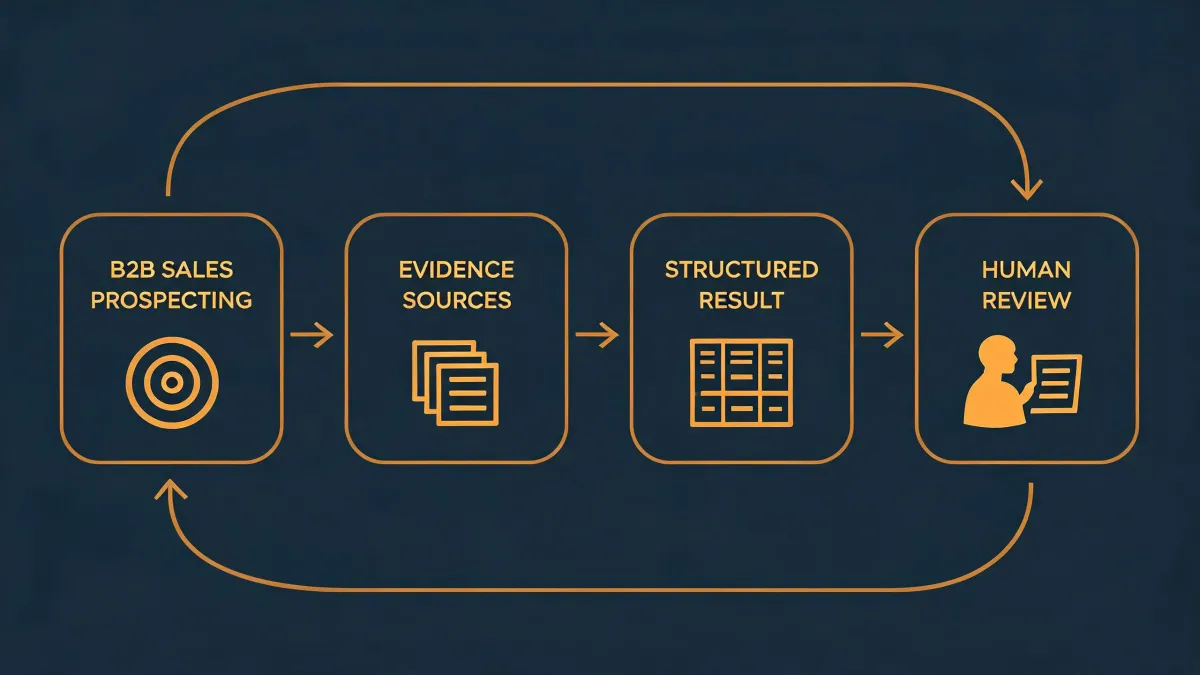
Everything I'd read about AI SDR tools suggested you could launch them and watch the meetings stack up. My experience on the quality side says the opposite: the more you automate outbound, the more important human-in-the-loop review becomes. Not because the writing is bad. Because a machine can't feel when an email is about the buyer's world versus your product's feature list.
One underrated reason is compliance. CAN-SPAM in the US and GDPR in the EU put responsibility on the sender, not on the enrichment vendor. A carefully reviewed list is a compliance story. A list full of guessed emails is a legal bill waiting to happen.
I remember a Thursday afternoon when marketing asked for a 200-person campaign before a conference. Normally I would take a full day to validate a segment. I had four hours. I narrowed the list from 1,000 prospects to 200 with actual triggers, approved the email after changing a generic opener, and spent the next two days refreshing the inbox. Even after sending, I kept second-guessing: what if a domain was stale, what if I approved too fast? Finally the first bounce report landed. It wasn't perfect. But the failures were explainable, and that's the real quality bar.
But Doesn't Human Review Break Scale?
It does if you review every sentence manually. That isn't how we implement it. Agent-native prospecting turns a contact into a research case, not a database row. The AI builds the draft and flags low-confidence data. A human reviewer checks samples, high-value accounts, and the logic behind each segment. On a 1,500-account campaign, I might check 15–20% of records and 100% of strategic accounts. It's editorial review, not line-by-line copy editing.
The second objection is more honest: “You work at okkigo; of course you defend the process.” True. My reply is that I reject my own team's work regularly. Last Tuesday, I sent back a polished internal campaign because it said “We enable organizations” to a group of startup founders. They would have laughed. Quality review isn't marketing theater; it's the reason the send didn't happen.
Also, if you haven't checked your domain authentication, no email finder can save you. SPF, DKIM, and DMARC are the baseline for any B2B team. Review them before you blame your b2b database.
Bottom Line: Sales Email Should Pass a Quality Gate
After four years of reviewing deliverables and one very odd quarter reviewing AI-generated campaigns, I keep coming back to the same rule: don't send anything a human can't defend. If someone asks, “Why this person, why now, why you?” and the answer is “because the lead list said so,” stop.
I can only speak to the B2B outbound context we live in at okkigo. If you're running untargeted blasts with no review layer, expect low trust, higher bounces, and very few replies. If you're building a smaller list with verifiable contacts and a specific reason to email each person, you're doing B2B sales right.
Whether you spell it okki-go with a hyphen or okkigo without one, the standard doesn't change: identify the trigger, verify the contact, review the email as a buyer would read it. Small doesn't mean unimportant. It means potential.