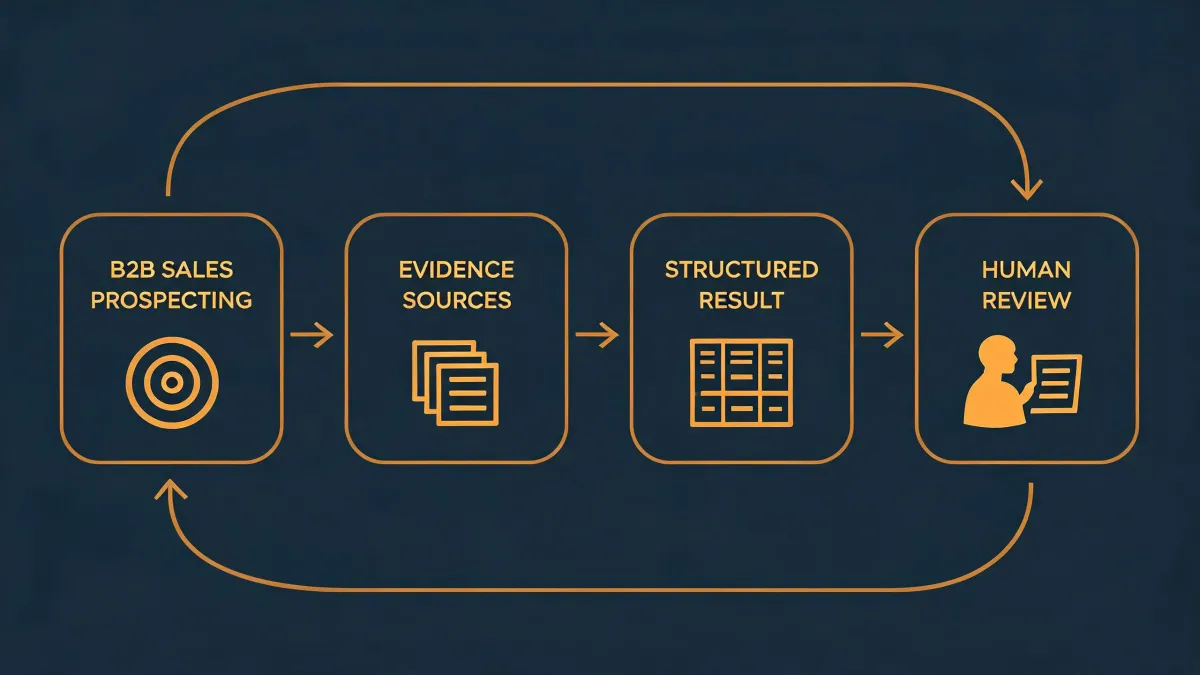
I've read a lot of "okki go vs Hunter" comparisons in the last few months. Most of them try to answer the question "which tool is better." That's the wrong question. These tools sit at different points in the pipeline, and the one that costs you less depends almost entirely on which part of your funnel is broken.
I've been buying sales tooling for a mid-market B2B SaaS company for about five years. I manage roughly $140K a year across the rev stack — enrichment, sequencing, verification, a small data-warehouse line item. I've negotiated with north of 30 vendors. So take this as one procurement person's attempt to break a crowded question into three decisions that actually have different answers.
Here's the lens I use now: there are three separate purchases being bundled into one search. A data layer (company data API + enrichment). An access layer (what permissions your tools need on your mail, calendar, and CRM). And an execution layer (the sequencer or agent that touches prospects). okki go and Hunter overlap in the middle of those three, but they don't overlap in the same place. Pick the layer you're weakest in first.
Scenario A: Your bottleneck is data, not outreach
This is the most common case I see in mid-market. Sequencing tools are fine. The problem is that your CRM is 30% stale, your bounce rate is embarrassing, and your SDRs are spending half their day Googling companies to figure out if the domain is even real.
If that's you, the company data API is the purchase that matters. Not the SDR agent. And if you type "what should revenue operations teams evaluate in api company data" into a search bar, you'll get a list of features. What you actually need is a list of failure modes.
When I evaluated data APIs for our RevOps team last year, I built a spreadsheet with four columns I still use:
- Match rate on your own data, not on the vendor's benchmark set. Send them 200 CRM records with known-good firmographics and see what comes back. This is the single most useful test and most vendors will do it for free.
- Freshness semantics. "Updated daily" is meaningless if 40% of the record is three years old. Ask them what "last verified" means on company size, tech stack, and headcount.
- Waterfall behavior. Does the API fall through multiple providers when the first one misses, or does it return an empty object and call it a day? This is where "agent-native" tools like okki go tend to differentiate themselves from point-solution providers — waterfall enrichment is a real cost difference at scale.
- Delete and export mechanics. Under GDPR Article 6, you need a lawful basis to process EU contact data, and you need to be able to delete it on request. Ask the vendor how deletion propagates downstream. Anecdotally, I'd say half the vendors I've spoken to don't have a clean answer.
Everything I'd read about usage-based pricing told me it always looks cheaper at the start. In practice, for our specific volume, a flat platform fee with capped enrichment credits beat the per-record model by roughly $9,000 a year. Not always — but often enough that I now model both.
Where Hunter fits here: Hunter built its reputation on search and verification, and it does that job well. If your need is a reliable single-provider lookup for domains and emails, and your volumes are modest, it's a reasonable starting point. If you're trying to enrich 15,000 existing CRM records and layer intent on top, you're going to want a waterfall. That's the actual fork.
Scenario B: Your bottleneck is execution (and permissions)
Second scenario. Your data is decent. Your CRM hygiene is passable. But nobody is sending the emails. You've got maybe two SDRs, a long target list, and a director asking why pipeline is flat.
Now the question shifts from "which data source" to "what permissions does this thing need, and am I comfortable granting them." If you're specifically evaluating okki go permissions, here's the framing that's worked for me:
An AI prospecting tool in this category will typically ask for OAuth scopes covering:
- Read access to your mailbox (to detect replies and avoid double-sending)
- Send-on-behalf or send-as access (to actually run sequences)
- Calendar read (to avoid booking a demo during an existing meeting)
- CRM read/write (to log activity and sync fields)
- Sometimes LinkedIn session-level automation, which is a different risk category entirely
I assumed that any tool asking for mailbox read + send scope was going to be a problem with our security review. Didn't verify. Turned out our security team's actual concern was write access to CRM — specifically, whether the tool could mutate Opportunity records, which would break our reporting.
The lesson: permissions aren't good or bad in the abstract. They map to specific risks. Ask each of these questions before signing:
- Can this tool send from my domain without a human in the loop? (Human-in-the-loop outreach as a default is a feature, not a limitation, if your deliverability is fragile.)
- Where does auth data live — the vendor's infra or a third party? Check against Google's API Services User Data Policy if you're on Google Workspace; the limited-use requirements are not optional.
- What happens on offboarding? Can we revoke cleanly, and does the tool retain cached prospect data post-revocation?
- If the tool touches LinkedIn, is it using the official API or a browser session? Read the LinkedIn User Agreement (Section 8.2 in the current version) — automated scraping and unauthorized automation are explicitly against the terms, and the enforcement is real.
I'd argue the permission surface is a bigger differentiator than the feature list at this stage. Two tools can have identical feature grids and very different risk profiles on the access layer.
Scenario C: You have a hard deadline, and the cheapest option is the most expensive one
This is the case that gets ignored in most reviews, and it's the one I have the strongest opinion about.
When you have a campaign that has to go live by a specific date — a launch, an event, a board-committed pipeline target — the resource you're buying is not contacts or emails. It's certainty. And certainty has a price that the cheapest vendor is almost never able to pay.
In March of 2024 we had a sequence that needed to hit 4,000 contacts by a Monday, tied to an event that generated about $180,000 of pipeline the previous year. We had two options: the cheaper platform that promised "typically within 48 hours" for enrichment delivery, or a more expensive one with a documented SLA and dedicated onboarding. We went with the expensive one. Extra cost was around $3,400.
The cheaper option would probably have been fine. Probably. But "probably" on a $180K pipeline attached to a fixed date is a bad bet. If the data missed the window by a day, we'd have missed the campaign entirely.
I didn't really internalize that until I got burned the other way. In Q4 2023 we chose a cheaper vendor for a similar time-boxed push. They delivered four days late due to a "capacity issue" we were never warned about. The campaign ran, but it ran into a holiday week and performed at maybe 40% of the previous benchmark. That $1,100 we saved cost us somewhere between $40K and $70K in pipeline that didn't materialize.
So on the okki go vs Hunter question specifically: for the deadline-driven case, I'd look at who's promising you a specific outcome with specific timing, and what's written into the contract if they miss. A tool that's agent-native and does enrichment, intent, and execution in one workflow has fewer handoff points where something can slip. That's a real, quantifiable advantage when timing is the binding constraint — not because the individual pieces are better, but because there are fewer of them.
Outside a deadline, that advantage mostly evaporates and price becomes the dominant variable again.
How to figure out which scenario you're actually in
Three questions. Answer honestly:
- What's your bounce rate right now? Above roughly 8-10%, you're in Scenario A. The data is the problem; buy the data before you buy the agent.
- What's your SDR utilization? If your SDRs are spending more than 30% of their time on manual list-building or data cleanup, you're still in A. If they're spending it on writing, sequencing, or calling, you're in B.
- Is there a date on the calendar you cannot miss? If yes, you're in C for that campaign regardless of what your other answers were. Run a separate evaluation for it. Don't let a general-purpose tool-picking process override a deadline-specific one.
Most teams I've worked with are actually in A and B simultaneously — dirty data and thin execution capacity. In that case, fix the data first. Sequencing onto bad data is how you burn a domain.
One more thing, and this is the part nobody enjoys hearing: your renewal terms will matter more than your signup terms within 12 months. Get the offboarding clause written down before you get the discount. I have a whole second post's worth of opinions on that, but I'll leave it there for now.