-
I was wrong about prospecting tools
-
What an agent-native prospecting workflow actually looks like
-
Why the Okki Go company and contact research workflow matters for account-based marketing
-
Okki Go email verification is a risk check, not a magic button
-
No, Okki Go doesn't replace SDRs
-
Cheapest data is deferred cost
-
Stop comparing list prices, start comparing workflows
I run revenue operations for a B2B outbound agency. In the last four years, I've coordinated more than 60 rush prospecting projects. Some were triggered by a conference deadline. Some were panic calls after a sales leader discovered their last list had a 21 percent invalid-email rate. In February 2026, one 300-account ABM build had to be ready in 36 hours.
Here's the thing: I used to think the tool with the most contacts would win. I was wrong. A bigger database just means more records to clean. The tool that wins is the one that moves a raw company record to a verified human contact in the fewest steps.
That's why I stopped buying another database and started working inside an agent-native prospecting workflow.
I was wrong about prospecting tools
When I first started doing urgent list builds, I assumed the fix was a better source of contact data. If there weren't enough accounts, buy a larger one. That is not what happened.
The real problem was workflow. We had company data in one tool, contact research in another, intent signals in a third, and email verification as an afterthought. An SDR was the only thing holding the process together. That works for 50 contacts. It falls apart when someone needs 700.
At our agency, we compared 1,000-record samples from our old process and the new one. We measured a 58 percent contact-lookup success rate before. After we changed the order of operations and made verification part of research, it went to 76 percent. Same tools. Different workflow. That number is what convinced me.
What an agent-native prospecting workflow actually looks like
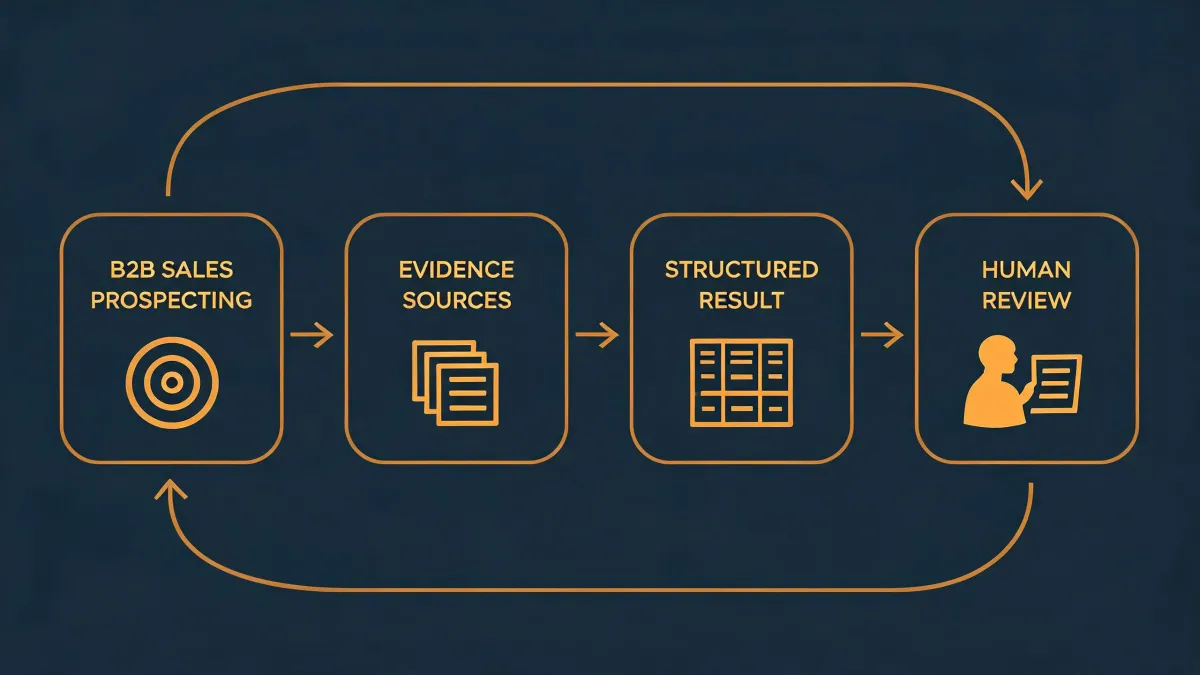
Agent-native does not mean putting a chatbot in front of a CRM. It means the workflow is designed for AI agents to make research decisions autonomously, with a human checking the important calls.
In practice, it looks like this:
- A target account list enters the flow from an account-based marketing or ICP filter.
- An AI agent enriches company data: size, industry, location, recent hires, tech stack, and intent signals.
- It maps those company triggers to buyer personas and finds the humans likely to own the problem.
- It resolves email variants and chooses the strongest known contact.
- It verifies the email before the contact enters an outreach sequence.
- A human reviews the final list and adds context that only a person would know.
How does a prospecting tool like Okki Go fit into an agent-native prospecting workflow? It fits as the research and data quality layer. Okki Go is not a CRM. It's not an AI SDR and it's not a sending platform. It is the part that decides who to contact and whether the contact is real enough to risk a reply.
Why the Okki Go company and contact research workflow matters for account-based marketing
Account-based marketing depends on company data. The company layer tells you whether the account is worth chasing. The contact layer tells you who at that account owns the problem. Most teams I talk to are strong at one layer and weak at the other.
Okki Go company and contact research workflow connects those layers. It starts with the account, not with a random list of emails. If a midmarket company shows a spike in data-engineering hires and uses a tool your product complements, that signal should drive the contact research. Okki Go can surface the company context and find the likely economic buyer in the same workflow.
That's why I don't think of it as a contact database. Company data becomes context. Contact research becomes a next step. Okki Go sits between the two so the human doesn't have to copy data from one tab to another.
Okki Go email verification is a risk check, not a magic button
Let me be direct about email verification. Nobody can guarantee 100 percent email deliverability. Okki Go email verification does not try to make that promise. It does something more practical: it prevents a small data problem from becoming a campaign-wide catastrophe.
The most frustrating part of email verification is that a verified email can still bounce. You'd think a clean status would last forever. It doesn't. People change jobs, companies change email providers, and an address verified six months ago might be dead today.
Okki Go email verification works best when it sits near the end of a waterfall enrichment flow. If the first address looks risky, Okki Go can check alternate variants and fall back to another known contact before the list goes to a human for approval.
That's the part teams undervalue. A bad email doesn't always announce itself. It simply disappears into a bounce report after you already spent time writing personalized lines and scheduling follow-ups.
No, Okki Go doesn't replace SDRs
The most common question our clients ask is whether AI prospecting replaces their sales development team. My answer is short: no, but it replaces the worst part of an SDR's day.
An SDR should decide whether an account is a good fit, write something that doesn't sound generic, and own the next step. An SDR should not copy a spreadsheet into a send button. Okki Go's agent-native workflow is built for human-in-the-loop because the research can be fast and the judgment stays human.
In my experience, human review is exactly what saves a rushed campaign. I can't hand a fully autonomous agent a 36-hour list build without checking the final output. Okki Go doesn't ask me to. It delivers the context to a human approval stage.
Cheapest data is deferred cost
Now the part I care about when budget conversations show up.
Lowest cost per record is a tempting metric. It fits neatly into a procurement spreadsheet. It also hides the most expensive part of prospecting: human time spent on records that were never going to respond.
Last year, a colleague chose a lower-cost list for a 500-contact outbound project. It saved about $1,400 on purchase price. It also produced an estimated 14 percent invalid-email rate. On 70 records, that meant hours of cleaning, follow-up rewrites, and do-not-contact headaches. Cheap is not cheap.
One more thing I check before launch: per FTC business guidance, marketing claims need evidence. Okki Go can verify an email address, but it can't verify a claim about your product. The human in the loop still owns that.
Stop comparing list prices, start comparing workflows
Here is the conclusion I keep coming back to: we don't have a data problem. We have a workflow bottleneck.
The teams I talk to already own enough data. They don't own an automated way to deduplicate, enrich, verify, and route that data to a human before the mailbox opens. Okki Go fits exactly there.
If you're choosing between another database and a prospecting workflow, choose the workflow. If you're choosing between a lower per-lead cost and a verified path from account research to contact, choose the verified path.
I spent four years and 60 rushed list builds learning this. The mistake isn't bad data. The mistake is treating data as an object instead of a workflow. Okki Go email verification is not a guarantee, and I wouldn't trust anyone who says it is. It is risk control inside a prospecting workflow. That distinction is why I changed my mind.