-
The Surface Problem: You’re Asking About the Wrong Layer
-
The Deep Problem: Prospecting Has Been Broken Into Unconnected Tasks
-
The Cost of Calling Okki Go a LinkedIn Scraper
-
Where Okki Go Human-in-the-Loop Outreach Fits
-
How Website Visitor Tracking Fits Into an Agent-Native Prospecting Workflow
-
So, Is Okki Go a Sales Prospecting Skill?
I get a variation of the same question a lot: “Is Okki Go a sales prospecting skill?” On the surface, it seems like a simple classification question. In practice, it usually means something closer to, “If an AI BDR and an agent-native workflow take over the repetitive parts, what is my SDR team actually supposed to get good at?”
In my role, I help B2B teams fix urgent outbound problems. I’ve rebuilt over 90 prospecting workflows in the last three years, many of them with a funding round or a launch date hanging over the room. So I don’t answer with a one-liner. The way we frame that question determines whether we fix the process or just buy another tool.
The Surface Problem: You’re Asking About the Wrong Layer
The literal answer is no. Okki Go is not a skill in the same way “lead generation,” “cold email,” or “account research” are skills. It is a platform. You wouldn’t list a wrench as a plumbing skill. Tools are not talents; they’re multipliers of them.
But that answer deserves more context. When someone asks whether Okki Go is a sales prospecting skill, they’re usually sensing that many old SDR tasks are now automated. Their real worry is role identity. If a machine can scrape LinkedIn, enrich contacts, verify emails, and draft follow-ups, what’s left for a person to do?
That’s the wrong way to look at it. Prospecting was never just the tasks. It was the judgment about which tasks matter, and in what order.
The Deep Problem: Prospecting Has Been Broken Into Unconnected Tasks
Here’s the thing I notice whenever I triage a broken outbound workflow: the problem is rarely a weak rep or a lazy vendor. It is isolated tasks. The scraper finds names. The verifier tests emails. The intent tool identifies accounts that are showing signals. The SDR writes sequences. Each piece looks fine on its own, but the handoffs between them leak time, context, and trust.
Last November, I sat with a RevOps lead whose team was missing every window that mattered. The target accounts were visiting the pricing page. The LinkedIn scraping effort had produced contact lists. The AI BDR had drafted messages. But the list lived in a spreadsheet, the visitor data lived in a separate dashboard, and the outreach template lived in yet another tool. By the time the human being put all three together, the account had already gone cold. That’s not a people problem. That’s a chain-of-certainty problem.
When I’m triaging outbound under a deadline, my first question is not “Which AI SDR are you using?” It’s “What has to be true for the right person to get the right message at the right time?” The answer almost never fits into one skill tag.
The Cost of Calling Okki Go a LinkedIn Scraper
The phrase “LinkedIn scraper” is doing a lot of damage to B2B sales teams.
Scraping is extraction. It gives you raw names, titles, and profile URLs. It cannot tell you if the person changed roles last week, whether the company is still in your ICP, or whether they walked into your website after reading a review. If the workflow starts and ends at scraping, what you have is an unverified list, not a pipeline.
This is where agent-native prospecting differs from the older “spray and pray” pattern. Instead of treating data as a one-time export, it treats data as a live workflow. Okki Go uses waterfall enrichment: if one source can’t provide a verified email or a meaningful firmographic field, it asks the next source. If the next source has intent data, it surfaces that too. The result is not necessarily more contacts; it’s more certainty about the contacts you already have.
When I compare two implementations side by side—same account list, same sellers, one using a manual scrape-and-upload flow, the other using an agent-native process with enrichment and human-in-the-loop review—the difference is obvious. The first team is busy. The second team is clear. They know which accounts to open, which person to approach, and what the conversation should be about. I’m not saying manual prospecting can’t work; at smaller volumes, it absolutely can. But under a tight deadline, busy and clear are not the same thing.
Where Okki Go Human-in-the-Loop Outreach Fits
Human-in-the-loop is not a compliance afterthought. It is the part that keeps automated prospecting from sounding like automated prospecting.
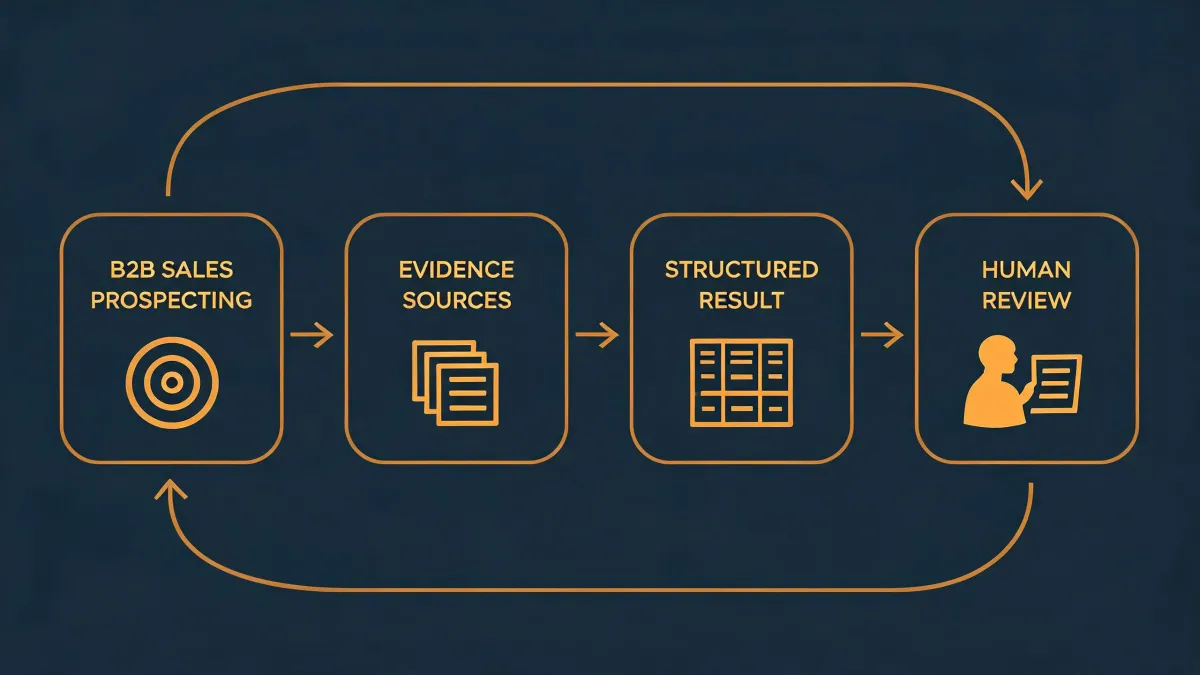
In an agent-native workflow, the AI BDR does the work that scales well: research, reconciliation, enrichment, sequencing logic, and the first draft of a message. A human then reviews the actual communication before it goes out. That means the tone can be adjusted, the personalization can be made specific, and the final decision to engage a prospect is made by someone who can stand behind it.
That may sound slower, and sometimes it is. But in urgent situations, certainty is worth more than raw volume. I’d rather send 25 human-reviewed messages to accounts with verified contacts and relevant intent than watch an SDR upload 2,000 scraped emails and wait for the spam folder to do its worst.
How Website Visitor Tracking Fits Into an Agent-Native Prospecting Workflow
One question I keep hearing from SDR teams is: “How does website visitor tracking fit into an agent-native prospecting workflow?” It deserves a concrete answer, not a dashboard demo.
Website visitor tracking is often viewed as a marketing analytics feature. In an agent-native prospecting workflow, it should be treated as a trigger event. Most outbound is sent blind. You have a list of accounts, but you don’t know when they are actually thinking about you. Visitor tracking changes that. When an account from your ICP visits your pricing page twice in a week, that’s not just an interesting metric; it’s the start of a workflow.
Here’s how that workflow should work:
- The visitor data resolves the company and checks it against your CRM to avoid duplicate outreach.
- The workflow scores the account. Is it in your ICP? Does it match the buyer persona? Are there other intent signals, such as recent job changes or active research around your product category?
- The agent runs enrichment and email verification before a human ever writes a word.
- The SDR or AE receives a decision package, not just another dashboard alert: the account, the person worth contacting, what they looked at, and a draft message that connects the visit to a relevant value proposition.
In that world, website visitor tracking doesn’t replace prospecting skill. It gives prospecting skill a target. It tells the human where to spend their attention.
So, Is Okki Go a Sales Prospecting Skill?
No. Okki Go is not a skill. But it’s also not just a tool. It’s a workflow that makes existing SDR skills matter at the moment they matter most.
If you define sales prospecting as “a set of tasks,” then yes, platforms will automate most of it, and the word skill starts to feel obsolete. If you define sales prospecting as “a set of decisions under uncertainty,” then the opposite is true. The human still decides who to contact, when to reach out, what evidence to use, and how to frame the first conversation.
When your team has three days before a pipeline review, you do not need another LinkedIn scraper and you do not need a debate about skill tags. You need a workflow that delivers the right account, the right contact, and the right context to a human in time to act. That is the thing Okki Go is actually built around: time certainty.