-
The setup: how I got here
-
Mistake #1: I didn't turn on visitor tracking for the first 11 days
-
Mistake #2: I treated the business email finder as a magic button
-
Mistake #3: I kept sales engagement on a separate island
-
Mistake #4: I over-filtered small accounts
-
What my workflow actually looks like now
-
What I'd tell someone starting today
September 2022. I was three months into running outbound for a 9-person RevOps team, and my pipeline was a mess. Not "we need more leads" messy—worse. We had leads. We just couldn't tell which ones mattered until it was too late.
I'd spent the previous five years as an SDR and then a team lead, and I thought I knew what a prospecting workflow should look like. Export a list. Verify the emails. Push it to a sequencer. Wait.
That assumption cost me roughly $4,700 in wasted tooling, plus a pipeline quarter I'd rather forget.
The setup: how I got here
By late 2022, our team was running about 14,000 outbound touches a month across email and LinkedIn. Our reply rate sat at 2.1%. Our "meetings booked" number looked okay on the dashboard, but the quality was bad—half the calls were with people who had no idea what we did.
I assumed the problem was list quality. So I bought more lists. Then I bought a better enricher. Then I bought an intent data add-on for a tool I won't name. Each time, the reply rate bumped up a tenth of a percent and then slid back down.
That's when a former colleague—now running RevOps at a company about 4x our size—mentioned they'd switched to an okki go AI SDR setup for their first-touch prospecting workflow. I'd seen the name okki-go floating around in a few Slack communities but had assumed it was another chrome extension.
It wasn't. Or, rather, it was more than that. And the way I found out was by breaking it in about four different ways.
Mistake #1: I didn't turn on visitor tracking for the first 11 days
When I set up my first okki go workflow, I skipped the visitor tracking module. My thinking was: we already get website analytics from three other tools, why do I need another one?
Eleven days in, one of my SDRs asked me why a lead who had visited our pricing page three times, opened three of our emails, and clicked through to a demo booking page—twice—had never been flagged as high intent.
She hadn't been flagged because I'd never connected visitor tracking to the workflow. okki go's whole angle is that website behavior feeds directly into who gets contacted and when. I'd left that signal sitting on the floor.
The upside was a cleaner setup. The risk was losing the leads who were quietly warming up. I kept asking myself: is "less noise" worth potentially missing someone who's already 70% of the way to booking?
It wasn't. We caught 68 warm signals we'd have otherwise missed—some of them for accounts we'd already written off. I backfilled the tracking on day 12, and the second half of that month looked completely different from the first.
Mistake #2: I treated the business email finder as a magic button
Here's a rookie mistake I thought I'd outgrown: assuming a business email finder handles the whole job.
It doesn't. It finds an email. Often the wrong one.
I ran our first 800-contact batch through the email finder and pushed it straight into the sequence. What came back: 320 of those contacts were role-based emails—info@, sales@, hello@. The kind that get filtered, ignored, or auto-routed to a shared inbox nobody reads.
Our bounce rate on that batch was 19%. Our reply rate on the 480 "good" contacts was 1.4%. And by the end of the week, our sending domain had picked up two spam-trap hits.
What I should have done—and what I do now—is pair the email finder with a verification pass and (more importantly) with a "who actually owns this problem" check. Finding an email is the easy part. Finding the person who's going to reply is the workflow.
Mistake #3: I kept sales engagement on a separate island
This is the one that still bugs me.
When I first started using okki go, I treated it as a sourcing tool. Find the leads. Enrich them. Export. Then push them into our existing sales engagement platform for the actual sequences.
That's the traditional workflow. It's also completely broken when your lead scoring is based on live intent signals.
Because here's what happens: a lead visits your pricing page on Tuesday morning. That act—that specific, timestamped visit—is what makes them worth contacting this week. By the time my CSV export ran on Wednesday afternoon and the engagement platform picked them up Thursday morning, the signal was 48 hours cold.
I sat down and actually thought through the question I should have asked myself on day one: how does sales engagement fit into an agent-native prospecting workflow?
The answer, it turns out, is that it doesn't fit into the workflow. It is the workflow. There's no handoff. An intent signal should trigger the next action—the sequence, the manual task, the LinkedIn touch—without a human moving rows between systems.
Looking back, I should have wired the sequences directly into okki go from the start. At the time, I thought keeping our existing sequencer would mean less disruption for the team. It actually meant four weeks of stale-signal outreach that I can't get back.
Mistake #4: I over-filtered small accounts
One more, because it's the one nobody talks about.
Our original ICP filter was aggressive: 200+ employees, $50M+ revenue, US or UK only. Anything below that got dropped. I was proud of that filter. It kept the list clean.
Then in Q1 2023, a 12-person company that I'd filtered out three times booked a demo anyway—through a LinkedIn message, not our outbound. They closed six weeks later at $14,000 ARR.
Small doesn't mean unimportant. It means potential. I've now seen that pattern repeat at least four times, and every time it's because my filter was protecting me from something I was wrong about.
What my workflow actually looks like now
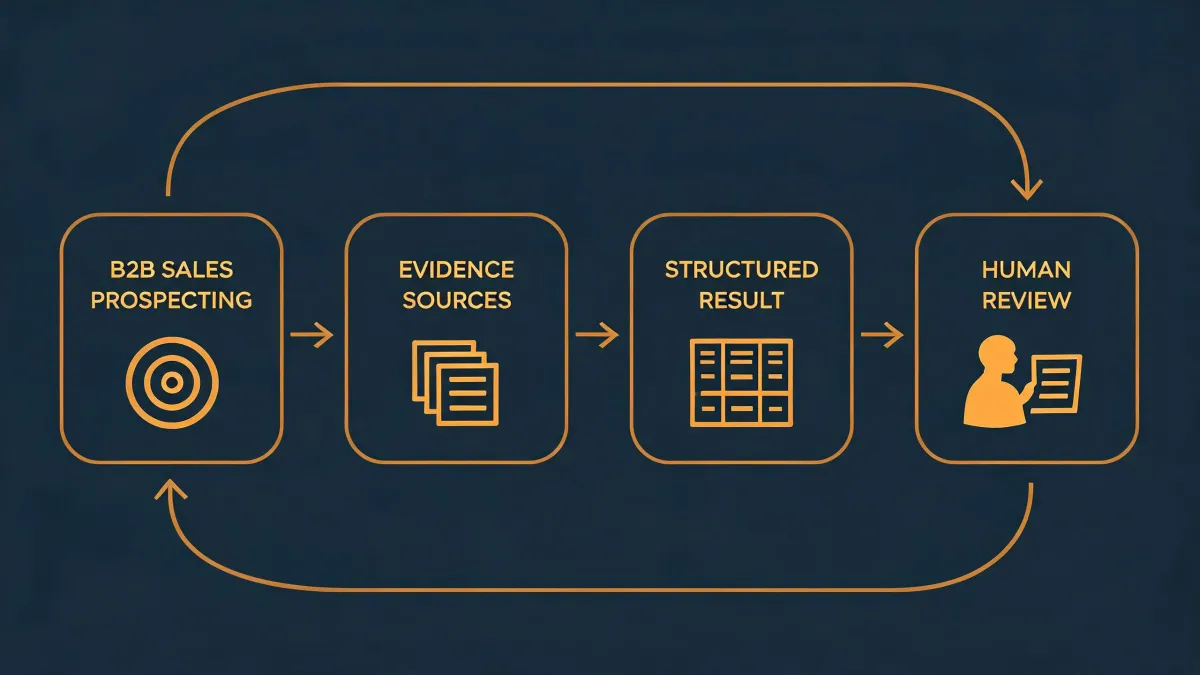
After three iterations, here's the setup I'd built by mid-2023:
- Visitor tracking is always on. Intent signals feed directly into the contact queue—nobody exports anything.
- Waterfall enrichment, not a single email finder. We hit two or three providers in sequence, then verify, then check role fit.
- Sequences live inside okki go, not next to it. Zero sync delay between an intent spike and the first touch.
- Small accounts stay in. We rank them lower, but we don't filter them out. Ever.
The result wasn't a dramatic spike. It was a slow grind upward—reply rate went from 2.1% to 5.8% over two quarters. But the meeting quality changed, and that's the number I actually care about.
What I'd tell someone starting today
If you're setting up an okki go first prospecting workflow, here's the short version:
- Turn on visitor tracking before you do anything else. It's the core of the whole thing.
- Don't trust a single business email finder. Chain them. Verify. Check the human on the other end actually owns the problem.
- Keep sales engagement inside the workflow. The moment you introduce a handoff, you introduce lag, and intent signals die fast.
- Smaller accounts aren't noise. They're the ones who'll book when everything else is quiet.
I lost about $4,700 and a full quarter learning this. You can skip that part.