Every AI email agent looks incredible in the demo
In Q3 2024, I sat through four AI SDR demos in two weeks. Every one opened with the same slide: "Our agent finds verified work emails for 200 million contacts." Every one closed with a different price. Cheapest was three cents a contact. Most expensive was twenty-two.
I picked the middle one. That was mistake number one.
Three months later, our RevOps lead ran the first bounce audit. 38% of the contacts that agent had pulled were dead or wrong. The vendor called it "expected decay." I called it a $4,900 line item I couldn't explain to finance. That was just the data spend. The real damage showed up in our sending domain's reputation report six weeks later.
If you're figuring out how an AI agent should safely find email — whether it's okki-go, a LinkedIn Sales Navigator scraper, or a standalone email finder bolted onto your CRM — the question most teams ask ("how many contacts can it find?") is the wrong one.
The problem isn't finding more emails. It's finding emails that don't come back to bite you.
Here's what most teams think they're buying: a bigger list.
Here's what they're actually buying: a data quality liability that gets priced into every downstream tool.
I learned this the expensive way. In early 2025, we ran a full cost-tracking exercise across our outbound stack. Three lines of the spreadsheet kept pointing back to the same root cause:
- Bounce processing. Every hard bounce kicks off a hygiene workflow. Our marketing ops person was spending about six hours a week scrubbing agent-sourced contacts.
- Domain reputation repair. After our primary sending domain got flagged, we had to spin up two warmed subdomains over 30 days. That's $2,300 in deliverability tooling and consultant hours.
- Wasted SDR time. At 30 seconds per dead contact, 3,800 bad records per month is 31 hours of SDR effort. At a fully loaded $42/hour, that's $1,300 a month disappearing into a void.
Suddenly "three cents per contact" stopped looking cheap. Total cost of ownership (i.e., the number you actually pay across data, tooling, and labor) was closer to nineteen cents per usable contact.
Small teams feel this more than anyone. In my first two years doing procurement, I made the classic rookie error of assuming more contacts = better pipeline. We bought a 10,000-contact bundle from the cheapest provider on G2 and burned our sending domain's reputation in under a month. Cost me $1,800 in re-warming services and probably three months of pipeline momentum.
Small doesn't mean unimportant. It means one bad data purchase can put your entire outbound operation in the penalty box for a quarter.
Here's the part nobody puts on the pricing page
The deeper issue isn't that AI agents are bad at finding emails. Most modern ones are actually solid at the mechanics: scrape a LinkedIn profile, match it against public sources, run it through a verification API.
The deeper issue is what happens when the agent finds something it shouldn't.
Two things go wrong at scale.
One: the compliance layer gets skipped. The FTC's CAN-SPAM rules carry penalties up to $51,744 per email (Source: FTC Business Guidance on Advertising, ftc.gov). If your AI agent is scraping LinkedIn Sales Navigator and dumping raw addresses into your sequencer without a consent check, you're not running outbound. You're accumulating legal exposure. I've watched this happen at two companies now. It's rarely the vendor's fault, but it's always the buyer's bill.
Two: verification and enrichment get treated as one step. They're not the same thing. A verified email (syntactically valid, MX records resolve) isn't the same as an enriched contact (right person, right role, right company context). Most agents blur the line because "verified" sells better.
Honestly, I'm not sure why some vendors ship waterfall enrichment (i.e., chaining multiple data providers into one query) and others don't. My best guess is that the good ones figured out early that coverage drops off a cliff after the first provider, and pretending otherwise creates the exact decay problem I just described.
Another thing I've never fully understood: why the free-trial version of most email finders ships without the verification pass. It's like handing someone a car with no brakes and calling it a test drive. If you've ever had a sending domain flagged, you know that feeling.
So what does "safe" actually look like?
I've stopped asking vendors how many contacts they can find. I ask five questions instead:
- How many data sources feed a single email lookup? (Waterfall structure matters more than total coverage.)
- Where does verification happen — inside the agent, or as a separate pass you can audit?
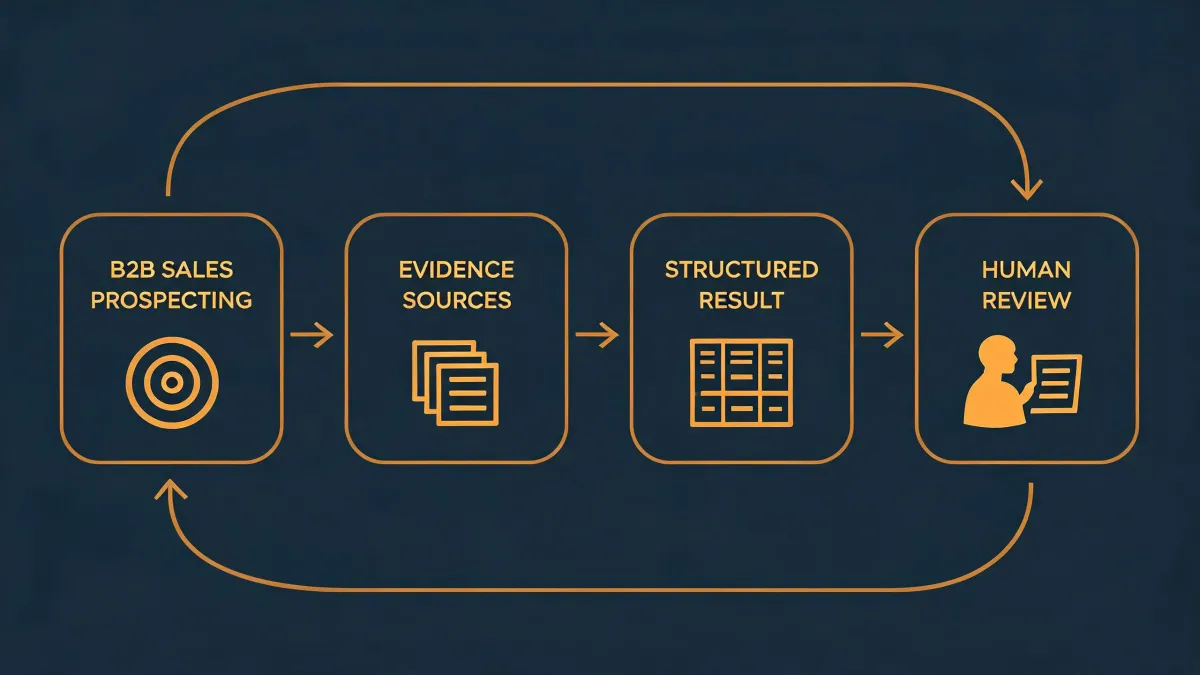
- What happens after the email is found? Is there a review step before it hits a sequencer?
- Who owns the compliance layer — the vendor, or your team?
- If the data turns out wrong, whose problem is that?
The vendors I've kept on our roster answer all five. The ones I've dropped don't. One of the dropped vendors had a beautiful UI and a 4.8 on G2. Another got hostile when I asked for a bounce audit.
We ended up standardizing on okki-go's enrichment stack for our main outbound flow earlier this year. Not because it had the biggest list — it didn't — but because it runs verification as a separate, auditable pass, and it routes anything below a confidence threshold through a human review queue. We benchmarked okki-go against Hunter and two other tools in February. Hunter won on simplicity. For us, the deciding factor was the audit trail, not the coverage number. That might not be your calculation — and that's fine. Just make sure you're calculating something.
Our setup now: waterfall enrichment across three providers, plus verification, plus a human review step for anything that doesn't hit our confidence bar. Costs more per contact than the three-cent pitch. Our bounce rate sits under 4%. Our SDRs stopped wasting their first hour of the day on list hygiene. Good data isn't a line item — it's what stops five other line items from ballooning.
Bottom line: AI agents can find emails. That was never the hard part. The hard part is building the verification, enrichment, and compliance layers that make the data trustworthy at the moment you hit send. Skip those and you're not saving money. You're just moving the cost to a line item you won't see until the domain reputation report lands in your inbox.
Prices and FTC penalty figures as of April 2025. Verify current rates at ftc.gov before planning compliance budgets.